Exercise is one of the most powerful things you can do for your health. It strengthens your heart, sharpens your mind, and adds years to your life. But here’s the catch — doing it wrong can sideline you with pulled muscles, stress fractures, or joint injuries that take weeks to heal.
The good news? Many common exercise injuries are highly preventable with the right habits.. Learning how to exercise safely isn’t complicated. It comes down to preparation, proper form, gradual progression, and knowing when your body is telling you to stop.
This guide covers everything you need to work out safely — whether you’re a complete beginner, getting back into fitness after a break, or managing a chronic condition. You’ll find structured tips, a pre-workout checklist, age-specific adjustments, and clear red flags that mean you should stop immediately.
Table of Contents
Quick Safety Summary
- Do I need a doctor first? Yes, if you have heart disease, diabetes, joint problems, are pregnant, or haven’t exercised in over a year.
- How much should I do? Around 150 minutes of moderate exercise per week plus 2 days of strength training.
- How much should I do? Around 150 minutes of moderate-intensity exercise per week plus 2 days of strength training (as recommended by the CDC’s Physical Activity Guidelines for Americans).
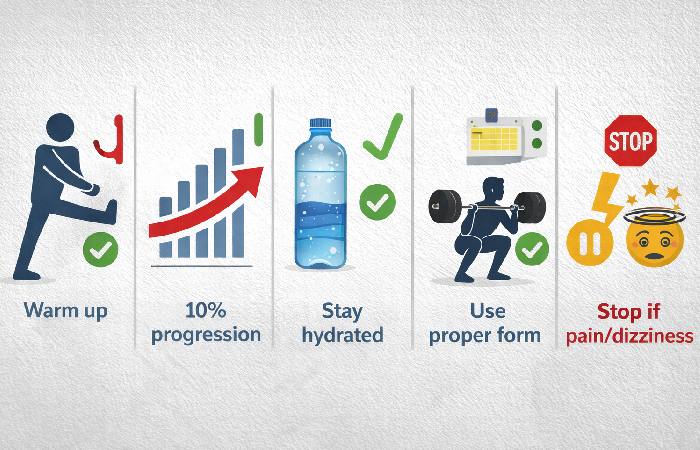
- How do I keep it safe? Warm up, use proper form, follow the 10% rule, stay hydrated, and take 1–2 rest days weekly.
- What should I stop for immediately? Sharp pain, chest discomfort, severe shortness of breath, dizziness, or feeling like you might faint.
- Does safety change by age/condition? Yes — older adults focus more on balance and joint protection; chronic conditions and pregnancy need modified, lower-impact options.
What Does It Mean to Exercise Safely?
Safe exercise is physical activity performed in a way that maximizes health benefits while minimizing the risk of injury, illness, or overtraining. It involves proper preparation, correct technique, appropriate intensity progression, adequate recovery, and awareness of your body’s signals.
Why Exercise Safety Matters
Every year, millions of people sustain exercise-related injuries that could have been avoided. Sprains, strains, and overuse injuries account for the majority of gym-related emergency visits.
The irony is hard to miss. People start exercising to get healthier — and end up injured because they skipped the basics.
Safe exercise habits protect more than your muscles and joints. They also protect your motivation. An injury in your first month of training can derail your fitness journey for months.
How to Warm Up and Cool Down Properly

Skipping your warm-up is like starting a car in freezing weather and immediately flooring it. Your muscles, tendons, and joints need time to prepare for movement.
Dynamic Warm-Up Routine (5–10 Minutes)
A proper warm-up gradually increases your **heart rate and blood flow** to working muscles. This makes muscle fibers more elastic and responsive, reducing tear risk.
Follow this sequence before every workout:
- Light cardio — 2–3 minutes of brisk walking, jogging in place, or cycling
- Leg swings — 10 per leg, front-to-back and side-to-side
- Arm circles — 10 forward, 10 backward
- Bodyweight squats — 10 reps at a controlled pace
- orso rotations — 10 per side
[!TIP] Why this works: Warm muscles absorb force more effectively than cold muscles. Research suggests that a structured warm-up can significantly reduce injury risk, especially in higher‑demand sports and activities.
Cool-Down and Static Stretching (5–10 Minutes)
After your workout, spend 5–10 minutes bringing your heart rate back to resting levels. This prevents blood from pooling in your extremities (which can cause dizziness).
- Walk slowly for 2–3 minutes
- Hold static stretches for 20–30 seconds each — hamstrings, quads, calves, chest, shoulders
- Focus on muscles you just worked
- Never bounce during static stretches — hold steady
8 Essential Tips for Exercising Safely
1. Use Proper Form and Technique

Bad form is the fastest route to injury. When you lift with a rounded back, run with overstriding feet, or squat with caving knees, you’re loading joints and tissues in ways they weren’t designed for. Poor technique is also one of the leading causes of chronic back injury, which can sideline you for weeks or longer.
How to get it right:
- Learn movements with bodyweight first before adding load
- Use mirrors or record yourself to check alignment
- If you’re unsure, book even one session with a certified personal trainer
- Slow down — controlled reps are safer and more effective than fast, sloppy ones
2. Follow the 10% Rule for Progression
This is the single most underrated safety principle in fitness. The 10% rule states that you should increase your weekly training volume — distance, weight, or duration — by no more than 10% per week.
Why it matters: Your muscles adapt faster than your tendons, ligaments, and bones. Jumping from 20 minutes of running to 45 minutes in one week puts connective tissue at risk — even if your lungs can handle it.
Example:
- Week 1: Running 10 km total
- Week 2: Running 11 km total (10% increase)
- Week 3: Running 12 km total
This applies to weight training too. If you squatted 60 kg this week, don’t jump to 75 kg next week.
3. Stay Hydrated Before, During, and After

Dehydration impairs your body’s ability to regulate temperature and deliver nutrients to working muscles. Even a 2% drop in hydration can reduce exercise performance and increase injury risk.
Practical hydration guide:
- Before: Drink 400–600 ml of water 2 hours before exercise
- During: Sip 150–200 ml every 15–20 minutes
- After: Drink 500–700 ml within 30 minutes post-workout
- In heat: Add an electrolyte solution for sessions over 60 minutes
4. Wear the Right Gear and Footwear
Your shoes matter more than your outfit. Worn-out shoes lose cushioning and support, increasing stress on your ankles, knees, and hips. If you lift weights regularly, using dedicated squat shoes can improve stability, form, and safety during heavy lower-body lifts.
- Replace running shoes every 500–800 km (or every 6–8 months of regular use)
- Choose shoes designed for your activity — running shoes for running, court shoes for tennis
- Wear moisture-wicking fabrics to prevent chafing and overheating
5. Mix Cardio, Strength, and Flexibility
Doing only one type of exercise creates muscle imbalances and increases overuse injury risk. As recommended by NHS guidelines on starting exercise safely, a balanced routine includes:
- Aerobic activity:150 minutes of moderate-intensity or 75 minutes of vigorous-intensity per week
- Strength training:2+ sessions per week targeting all major muscle groups
- Flexibility:Stretching 2–3 days per week
Cross-training challenges your body in different ways and prevents repetitive stress on the same tissues.
6. Listen to Your Body — Soreness vs. Pain
Not all discomfort is the same. Learning to distinguish normal soreness from injury signals is critical.
| Signal | What It Means | What to Do |
|---|---|---|
| Mild muscle ache 24–48 hours after exercise (DOMS) | Normal adaptation | Continue exercising at reduced intensity |
| Sharp, sudden pain during movement | Potential strain, tear, or sprain | Stop immediately, apply RICE |
| Pain that persists more than 72 hours | Possible overuse injury | Rest and consult a professional |
| Joint pain (not muscle-related) | Possible joint or ligament issue | Stop the aggravating movement immediately |
7. Schedule Rest and Recovery Days
Rest isn’t laziness — it’s where adaptation happens. Your muscles repair and grow stronger during rest, not during the workout itself.
- Take at least 1–2 full rest days per week
- Allow 48 hours between strength training the same muscle group
- Prioritize 7–9 hours of sleep per night — this is when human growth hormone peaks
- Active recovery (walking, gentle yoga, swimming) is fine on rest days
8. Be Mindful of Your Environment
Your surroundings affect your safety more than you might think.
- Hot weather: Exercise in early morning or evening, wear light clothing, watch for heat exhaustion symptoms (nausea, dizziness, confusion)
- Cold weather: Layer up, warm up longer, protect extremities
- Outdoor running: Wear reflective gear at night, run against traffic, stay aware of surfaces
- Home workouts: Ensure adequate space and stable flooring
Exercise Safety by Age and Condition
Safe exercise isn’t one-size-fits-all. What works for a 25-year-old marathon runner won’t work for a 70-year-old with arthritis. Here’s how to adjust.
| Group | Key Safety Priorities | Recommended Focus |
|---|---|---|
| Beginners (any age) | Form over intensity, gradual progression | Bodyweight exercises, walking, light yoga |
| Adults 25–44 | Progressive overload, injury prevention | Compound lifts, HIIT with proper form, mobility |
| Adults 45–64 | Joint protection, longer warm-ups | Low-impact cardio, resistance training, flexibility |
| Seniors 65+ | Balance training, fall prevention | Chair exercises, tai chi, walking, supervised training |
| Pregnancy | Modified positions, core safety | Prenatal yoga, swimming, walking (avoid supine after 1st trimester) |
| Chronic conditions | Medical clearance, adjusted intensity | Work with a physiotherapist or exercise specialist |
Safe Exercise for Beginners
If you haven’t exercised in months (or years), start with just 10–15 minutes of low-intensity activity, 3 days per week. Walking is a perfectly valid starting point — you don’t need a doctor’s clearance to go for a daily walk.
Build up gradually using the 10% rule. Most beginners who get injured do so in the first 4–6 weeks because enthusiasm outpaces conditioning.
Adjustments for Seniors and Older Adults
For adults over 65, the American Academy of Orthopaedic Surgeons recommends focusing on balance and fall prevention exercises alongside standard aerobic and strength work. Tai chi, water aerobics, and supervised resistance training are excellent choices.
Warm up for at least 10 minutes — older joints and muscles need more time to reach working temperature.
Exercising with Chronic Conditions or During Pregnancy
If you have heart disease, diabetes, high blood pressure, asthma, or joint conditions, get medical clearance before starting a new program. This isn’t about gatekeeping — it’s about getting the right intensity and exercise type for your situation.
During pregnancy, avoid exercises that involve lying flat on your back after the first trimester, high-impact jumping, or heavy overhead lifting. Prenatal yoga, swimming, and walking are safe and effective for most pregnant individuals.
Red Flags — When to Stop Exercising Immediately
Some signals mean you should **stop your workout right now** and seek medical help if symptoms persist.
Warning Signs During a Workout
- Chest pain or pressure — could indicate a cardiac event
- Severe shortness of breath disproportionate to effort
- Dizziness, lightheadedness, or feeling faint
- Sudden sharp pain in a muscle or joint
- Nausea or vomiting during moderate activity
- Heart palpitations** or irregular heartbeat
- Numbness or tingling** in your extremities
When to See a Doctor
Consult a healthcare professional if:
- Pain lasts more than 72 hours after exercise
- You experience swelling that doesn’t subside with rest and ice
- A joint feels unstable or gives way
- You have recurring pain during the same movement pattern
- You’re over 45 and starting vigorous exercise for the first time
Common Exercise Safety Mistakes to Avoid
These are the errors that send people to the physio’s office:
- Skipping the warm-up — “I’ll save time” costs you weeks of recovery if you get injured
- Doing too much too soon — violating the 10% rule is the #1 cause of beginner injuries
- Ignoring pain — pushing through sharp pain turns minor strains into serious tears
- Never taking rest days — overtraining syndrome causes fatigue, mood changes, and declining performance
- Copying advanced exercises from social media — filmed highlights don’t show the years of training behind the movement
- Neglecting flexibility and mobility work** — tight muscles restrict range of motion and increase strain risk
- Exercising through illness** — a fever means your body is already fighting; adding exercise stress makes recovery harder
Who Should Prioritize Exercise Safety (And Who Can Relax)
This guide is especially important for:
- Complete beginners starting their first exercise program
- People returning to fitness after a long break or injury
- Adults over 50 or those with joint concerns
- Anyone managing a chronic health condition
- Pregnant individuals
Less urgent for (but still relevant):
- Experienced athletes with established routines and body awareness
- People with regular access to coaching or personal training
Even seasoned exercisers get injured when they get complacent. The basics never stop mattering.
Final Verdict
Exercising safely doesn’t mean exercising timidly. It means being **strategic** — warming up properly, progressing at the right pace, listening to your body, and knowing when to push and when to rest.
The 10% rule, proper form, and scheduled recovery are your three non-negotiable foundations. Build every workout on them, and you’ll stay active, injury-free, and progressing for years to come.
Start where you are. Progress deliberately. And never skip the warm-up.
Frequently Asked Questions
Q: How long should I warm up before exercising?
A: Aim for 5–10 minutes of light cardio followed by dynamic stretches. Older adults and those exercising in cold weather should extend this to 10–15 minutes for adequate muscle and joint preparation.
Q: What is the 10% rule in exercise?
A: The 10% rule means increasing your weekly training volume — whether that’s distance, weight, or duration — by no more than 10% per week. This allows your tendons, ligaments, and bones to adapt alongside your muscles.
Q: Can I exercise every day safely?
A: You can be active daily, but avoid intense exercise targeting the same muscle groups on consecutive days. Schedule at least 1–2 full rest days per week and allow 48 hours between strength sessions for the same muscles.
Q: Should I exercise when I’m sick?
A: Use the “neck check.” If symptoms are above the neck (runny nose, mild congestion), light exercise is usually fine. If symptoms are below the neck (fever, body aches, chest congestion), rest until you recover.
Q: What are the signs I’m exercising too hard?
A: Watch for persistent fatigue, declining performance, mood changes, trouble sleeping, recurring injuries, and elevated resting heart rate. These are signs of overtraining and mean you need more recovery time.
Q: Do I need a doctor’s clearance before starting exercise?
A: For basic activities like walking, no. But consult a healthcare professional before starting vigorous exercise if you have heart disease, diabetes, high blood pressure, joint problems, or haven’t exercised in over a year.