
Active Kids Indoor Activities: 40+ Energy-Burning Ideas for Every Age (2026 Guide)
It’s raining. Your kids have been inside since 9 a.m. The couch is a trampoline, the hallway is a racetrack, and you’ve already heard “I’m bored” eleven times. Sound familiar?
Finding active kids indoor activities that actually burn energy — without destroying the house or requiring a trip to the craft store — is one of the genuinely hard parts of parenting. Most lists hand you 50 ideas and leave you to figure out which ones work in a 700-square-foot apartment with a noise-sensitive downstairs neighbour.
This guide is different. Every activity here is sorted by age group, space requirement, and cleanup difficulty — so you can find the right one in under two minutes. We’ve also included the developmental reason each activity matters, because “fun” is great, but knowing why it works makes you a more confident parent.
Table of Contents
Quick Answers
- How much activity do kids need? → The CDC recommends 60 minutes of moderate-to-vigorous activity daily for children aged 6–17.
- Best for small spaces? → Simon Says, Freeze Dance, Tape Hopscotch — zero footprint, high energy output.
- Best for toddlers (2–4)? → Pillow obstacle courses and animal walks.
Best for school-age (5–10)? → Scavenger hunts, balloon volleyball, yoga challenge cards. - Best for tweens (11+)? → Dance cardio, resistance band workouts, DIY obstacle course.
- No equipment needed? → Yes — at least 20 activities here require nothing beyond what’s already in your home.
Why Active Kids Indoor Activities Actually Matter
Active kids indoor activities are structured or unstructured physical play designed to develop gross motor skills, burn excess energy, and support cognitive function — all within the home. They work by engaging large muscle groups (legs, core, arms) through movement patterns like jumping, crawling, balancing, and throwing.
But here’s what most activity lists skip entirely: movement isn’t just about burning energy. It’s about brain development.
According to the CDC’s research on physical activity benefits for children, regular physical activity in kids is directly linked to improved academic performance, better sleep quality, reduced anxiety, and stronger concentration. The brain and body aren’t separate systems — especially in children under 12.
And the stakes are higher than most parents realise. Data from a CDC review found that approximately 50.4% of teens now report 4 or more hours of daily screen time, with high screen-time users significantly more likely to have low physical activity levels. Indoor movement breaks aren’t a luxury. They’re a counterbalance.
The Science Behind “Gross Motor” Play
Gross motor skills are large-scale movements using the body’s major muscle groups: running, jumping, climbing, throwing, balancing. These skills develop rapidly between ages 2 and 10, forming the physical foundation for everything from handwriting to sports to self-regulation.
Pediatric therapists also emphasise proprioceptive input — the sensory feedback muscles and joints send to the brain during heavy physical work. Activities like wheelbarrow walks, bear crawls, and carrying weighted items provide deep proprioceptive input. Research in occupational therapy consistently links this to calmer, more focused behaviour in children.
In plain language: a child who has had a good bout of physical activity is neurologically better prepared to sit still and concentrate. That’s the real payoff.
High-, Medium-, and Low-Energy Indoor Play Framework
When you’re stuck inside all day, it helps to think in terms of energy levels instead of random ideas. Matching an activity to your child’s current energy level makes it far more likely to work — and last.
High-energy (bounce-off-the-walls mode):
- Obstacle courses
- Dance parties and freeze dance
- Relay races and pillowcase races
- Indoor “snowball” fights with rolled-up socks or paper
Medium-energy (active but controlled):
- Balloon volleyball / balloon keep-it-up
- Indoor bowling and target toss
- Scavenger hunts
- Animal walk races
Calm-but-active (wind-down movement):
- Kids yoga and stretching
- Balance/tightrope walk on tape
- Fort building and crawling
Use this: start with one high-energy activity to burn off steam, follow it with a medium-energy game, then finish with a calm-but-active option to ease into the next part of the day.
Active Kids Indoor Activities by Age Group
Toddlers (Ages 2–4): Big Movement, Small Risk
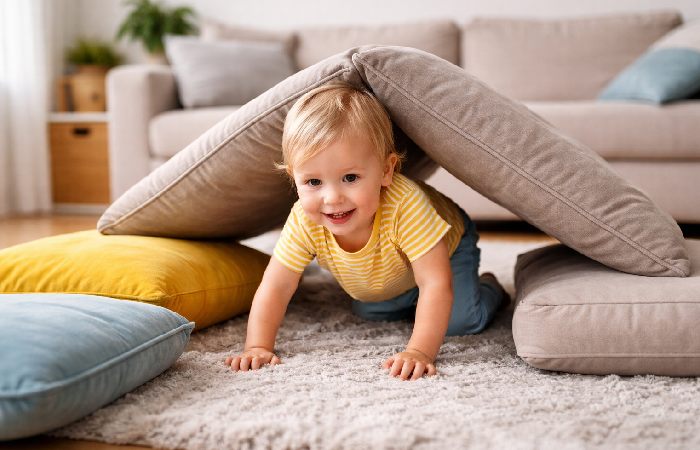
Toddlers need movement that is safe, repetitive, and sensory-rich. They don’t need rules — they need space to explore. Focus on activities that build balance and coordination without injury risk.
Top picks for toddlers:
- Pillow Obstacle Course — Stack couch cushions and pillows into tunnels and towers. Crawl through, climb over, roll off. Zero cleanup, maximum engagement.
- Animal Walks — Bear crawl, crab walk, frog jump, snake slither. Call out an animal and let them move across the room. Great proprioceptive input, no equipment required.
- Balloon Keep-Up — Blow up a single balloon and keep it off the floor. Toddlers can play solo or with a parent. No sharp edges, soft landing.
- Dance Freeze — Play music, pause it randomly. Freeze when it stops, dance when it starts. Develops body awareness and auditory attention.
- Indoor Bubble Chase — Blow bubbles and have the toddler pop them. Combines movement, visual tracking, and fine motor coordination.
- Space needed: Any room with cleared floor space. Cleanup rating: ★☆☆ (minimal to none)
Early School Age (Ages 5–8): Rules, Roles, and Repetition
Children in this age group are ready for simple structured games with clear rules. They want to win, they want fairness, and they want to do it again. Repetition is learning at this stage.
Top picks for ages 5–8:
- Indoor Scavenger Hunt — Write clues on index cards and hide them around the house. Each clue leads to the next. Running, reading, and problem-solving, all in one.
- Balloon Volleyball — Tie a piece of string between two chairs. Hit the balloon over the “net.” Teaches hand-eye coordination and turn-taking.
- Hopscotch with Painter’s Tape — Create a grid on the floor. Peel it off cleanly when done — no residue, no damage.
- Simon Says (Movement Edition) — Classic game, but focus purely on physical commands: “Simon says do 10 jumping jacks,” “Simon says balance on one foot for 5 seconds.”
- Yoga Challenge Cards — Draw or print simple pose cards. Kids take turns drawing a card and holding the pose for 10 seconds. Balance, flexibility, laughter.
- Indoor Bowling — Line up empty plastic bottles or toilet paper rolls. Use a soft ball. Score it like real bowling.
Space needed: Living room or hallway. Cleanup rating: ★★☆ (minor — tape, scattered items)
Older Kids (Ages 9–12): Challenge, Competition, and Creative Play
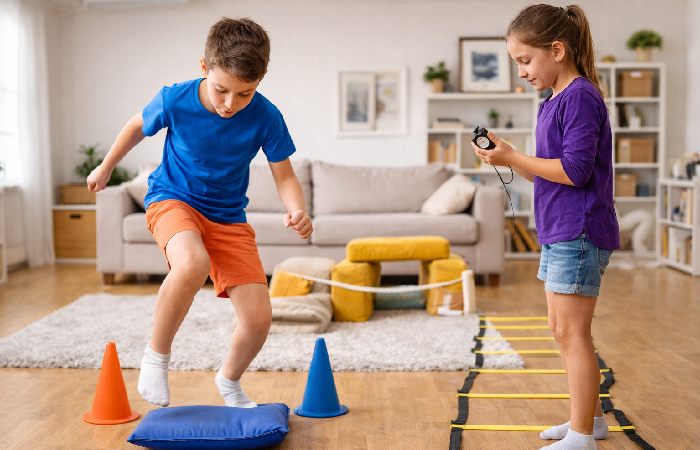
Kids in this range want challenge and autonomy. They’re motivated by personal bests, friendly competition, and creative control. Give them structure with room to improvise.
Top picks for ages 9–12:
- DIY Obstacle Course — Use furniture, tape-marked zones, cushion tunnels, and hallway markers. Time each attempt. Kids will run it 15 times trying to beat their record.
- Just Dance / Dance Cardio — Free YouTube dance cardio routines exist for every level. 20 minutes equals a real workout at this age.
- Resistance Band Exercises — Basic sets cost under $15 and are safe for pre-teens. Squats, rows, and shoulder press can all be done in a bedroom.
- Stair Exercises — Step-ups, timed circuits up and down. Turns any multi-level home into a free gym. Monitor form to avoid trips.
- Floor is Lava — Define lava zones, assign safe islands (cushions, rugs). Plays longer than you’d expect and requires real physical problem-solving.
- Plank and Push-Up Challenge — Set a daily target and track it on a wall chart. Kids this age respond well to visible progress.
Space needed: Varies — most work in a living room or hallway; stair exercises need a staircase. Cleanup rating: ★★☆ (moderate — cushions, rearranged furniture)
Don’t Forget Older Kids and Tweens
Older kids and tweens want activities that feel more grown-up, not babyish. Alongside obstacle courses and fitness challenges, try simple kitchen projects, strategy-heavy board games, or creative hobbies like jewellery or candle making that let them express independence while still spending time with you.
Quick-Reference Activity Table: Space, Age & Cleanup
| Activity | Best Age | Space | Cleanup | Equipment |
|---|---|---|---|---|
| Pillow Obstacle Course | 2–5 | Small room | ★☆☆ | None |
| Animal Walks | 2–6 | Any | ★☆☆ | None |
| Balloon Keep-Up | 2–8 | Any | ★☆☆ | 1 balloon |
| Dance Freeze | 2–10 | Any | ★☆☆ | Music |
| Simon Says (Movement) | 4–10 | Any | ★☆☆ | None |
| Indoor Scavenger Hunt | 5–10 | Whole home | ★★☆ | Index cards |
| Balloon Volleyball | 5–10 | Living room | ★☆☆ | Balloon + string |
| Tape Hopscotch | 4–9 | Hallway | ★★☆ | Painter’s tape |
| Yoga Challenge Cards | 5–12 | Any | ★☆☆ | Cards |
| Floor is Lava | 6–12 | Living room | ★★☆ | Cushions |
| DIY Obstacle Course | 7–12 | Large room | ★★★ | Household items |
| Dance Cardio / Just Dance | 8–14 | Any | ★☆☆ | Screen + space |
| Stair Exercises | 9–14 | Staircase | ★☆☆ | None |
| Resistance Band Workout | 10–14 | Bedroom | ★☆☆ | Resistance bands (~$15) |
| Indoor Bowling | 5–12 | Hallway | ★★☆ | Bottles + soft ball |
★☆☆ = Minimal ★★☆ = Moderate ★★★ = Full cleanup needed
Classic Games That Get Kids Moving
Some of the best indoor movement ideas are the classics — but with a slightly more active twist.
- The Floor is Lava — Scatter pillows, cushions, or towels across the floor. Shout “the floor is lava!” and kids must jump between safe spots without touching the ground. Simple, effective, endlessly entertaining.
- Simon Says Fitness — Play the classic Simon Says game, but use exercises as commands: “Simon says do five jumping jacks,” “Simon says hold a plank,” “Simon says crab walk to the door.”
- Hide-and-Seek (Active Variations) — Make it more active: when someone is found, they run to a home base instead of just being “out.” Or add a fitness penalty — found players do 10 squats or 5 star jumps before rejoining.
Apartment-Friendly and Small-Space Activities
This is the gap most guides miss completely. Urban parents face real constraints: low ceilings, thin floors, shared walls, limited square footage. The activities below are designed for high energy output with a zero-to-minimal footprint.
Engage Their Brains with Games and Creative Projects
On lower-energy days, mix active play with sit-down options like board games, card games, puzzles, and open-ended building toys such as blocks or Lego. Foster carers can even use part of their allowance from agencies like Fostering People to stock up on simple indoor activities that keep kids engaged without relying on screens.
Zero-Noise Activities (Downstairs Neighbour Approved)
- Bear Crawl Races — Race from one wall to the other on hands and feet, belly down. Silent, physically demanding, endlessly repeatable.
- Plank Hold Competitions — Who can hold the longest? Core strength, focus, total silence.
- One-Foot Balance Challenge — Stand on one foot with eyes closed. Tree pose. Warrior pose. Genuinely hard, completely quiet.
- Slow-Motion Everything — Challenge kids to walk, crawl, or do anything in extreme slow motion. Surprisingly tiring. Kids find it hilarious.
Low-Ceiling, Low-Impact Options
- Crab Walk Relay — Hands and feet on the floor, belly up, walk sideways. Intense for core and arms, stays low.
- Snake Slither — Lie flat, move across the floor using only arms. Perfect for hallways.
- Sit-to-Stand Intervals — Sit cross-legged, stand without using hands, sit back down. Repeat for 2 minutes. Sounds simple — it isn’t.
When You Have 10 Minutes and Nothing Else
- Jumping Jack Bursts — 30 seconds on, 15 seconds rest, repeat 4 rounds. Done in 3 minutes, genuinely exhausting.
- Indoor Relay — Two ends of the hallway. Run back and forth carrying a stuffed animal each lap.
- Wall Sit Contest — Back flat on the wall, thighs parallel to the floor. Kids will compete against themselves indefinitely.
The Developmental Benefit Framework
Not every activity is equal. Match the type to what your child actually needs at that moment — not just what’s on a list.
| Child’s State | What They Need | Activity Type | Example |
|---|---|---|---|
| Overstimulated, dysregulated | Deep proprioceptive input | Heavy work | Bear crawl, wheelbarrow walk, carrying stacked books |
| Restless, unfocused | Vestibular stimulation | Balance / rhythm | Yoga, balance beam (tape on floor), freeze dance |
| High energy, bored | Aerobic output | Cardio burst | Dance cardio, stair sprints, jumping jacks |
| Competitive, wants challenge | Structured challenge | Game with rules | Obstacle course, scavenger hunt, indoor bowling |
| Tired but won’t settle | Calm and slow down | Calming movement | Slow animal walks, gentle stretching, slow yoga |
Use this framework and you’re no longer guessing. That’s the difference between 5 minutes of chaos and 30 minutes of genuinely engaged play.
Common Mistakes Parents Make With Indoor Activities
These aren’t catastrophic errors. But they consistently cut short how long an activity lasts — and how much energy it actually burns.
- Setting it all up for them. Kids who help build the obstacle course play it longer. Ownership drives engagement.
- Stopping too soon. The first 5 minutes are always the noisiest. Most activities hit their stride at the 10-minute mark once kids understand the rules. Hold the line.
- Defaulting to screens too quickly. The first 3 minutes of any screen-free activity feel like resistance. Push through it — kids almost always engage once momentum builds.
- Skipping cleanup as a game. “Who can clean up fastest?” is itself a movement challenge. Don’t miss it.
- Treating it as age-locked. A 6-year-old and a 10-year-old can play balloon volleyball together with minor rule adjustments. Mixed-age play is developmentally valuable — don’t separate them unnecessarily.
Who These Activities Are For — and Who Should Pause
Well suited for:
- Parents and caregivers of children aged 2–12 looking for screen-free, energy-burning options on rainy days, holidays, or winter months
- Families in apartments or small homes needing low-impact, low-noise solutions
- Parents of high-energy or sensory-seeking children who struggle to settle
Teachers and childcare providers looking for structured indoor movement breaks
Proceed with caution if:
- Your child has a recent physical injury — check with your paediatrician before resuming high-impact activities like jumping or stair sprints
- Your child has a diagnosed sensory processing disorder — some proprioceptive activities can dysregulate rather than calm without guidance from an occupational therapist
- You’re in a space with fragile furniture or hard floors only — clear the activity zone before starting
Not designed for:
- Children under 18 months — supervised tummy time and sensory play are more appropriate
- Structured athletic training — these are play-based, not programme-based
Final Verdict: The Best Active Indoor Activities for Kids in 2026
No single activity works for every child, every day, in every space. But that’s exactly the problem with most guides — they give you 50 ideas and no framework for choosing.
The best active kids indoor activities match your child’s current state, fit your actual space, and require the least setup. Because the faster you start, the faster they’re moving.
Top 5 for most families:
- Pillow Obstacle Course — Toddler to age 8, any space, minimal cleanup
- Simon Says (Movement Edition) — Any age, any space, zero equipment
- DIY Obstacle Course — Ages 6–12, larger spaces, highest engagement ceiling
- Dance Cardio / Just Dance — Ages 6 and up, any space, 20+ minutes of real cardio
- Indoor Scavenger Hunt — Ages 5–10, whole-home, combines physical and cognitive challenge
Start with one. Use the developmental framework to choose the right one. And when your child asks to do it again tomorrow — that’s the real measure of success.
Take Learning Outside the Box Indoors
Indoor time is also a chance to follow your child’s curiosity. Let them pick a topic they love and explore it together online, then watch age-appropriate documentaries about nature, science, or history to keep their minds as active as their bodies.
Frequently Asked Questions
Q1: How can I keep my child active indoors when it’s raining all day?
A: Rotate through 3–4 different activity types across the day: start with high-energy (obstacle course or dance cardio), shift to structured (scavenger hunt or bowling), and wind down with calming movement (yoga or slow animal walks). This mirrors the natural rhythm of a school day and prevents overstimulation from a single activity type.
Q2: What are the best gross motor activities for kids at home?
A: The most effective gross motor activities involve whole-body movement: bear crawls, obstacle courses, jumping games, and balance challenges. These develop coordination, strength, and spatial awareness. According to the CDC’s physical activity guidelines, children aged 6–17 need at least 60 minutes of this type of movement daily.
Q3: Are there indoor activities suitable for high-energy kids in a small apartment?
A: Yes. Bear crawl races, crab walks, wall sits, plank holds, and slow-motion challenges are all effective — and produce minimal noise and vibration. Tape a hopscotch grid in the hallway with painter’s tape for a quick, removable option that works in under 10 square feet.
Q4: How much physical activity does my child actually need each day?
A: According to the CDC’s physical activity guidelines for children, children aged 6–17 need at least 60 minutes of moderate-to-vigorous physical activity every day. For children under 6, the guideline is active play throughout the day. Indoor activity breaks count toward this total.
Q5: Do indoor physical activities really help with focus and behaviour?
A: Yes, and the evidence is clear. The CDC’s research on physical activity benefits directly links regular movement to improved academic performance, reduced anxiety, better sleep, and stronger concentration. A 10–15 minute movement break mid-morning or mid-afternoon measurably improves a child’s ability to focus on what comes next.
Q6: What can a 10-year-old do when bored inside without screen time?
A: At 10, kids respond best to challenge and autonomy. Set them up with a timed DIY obstacle course they design themselves, a resistance band workout they can track, a dance cardio session, or an indoor bowling tournament with brackets they score. The key is a tangible goal — a time to beat or a score to chase.