Everyone has attempted the at home fitness ‘program’ at some point and if you are reading this, you probably know what a squat is, you‘ve done a youtube work out at some time in your life, you have been through the third week dip; where the ‘newness’ subsides and the exercises quietly disappear.
This is a step by step, levels based system of designing your home workouts that truly makes progress, whether you haven‘t worked out in a while, are starting from scratch, or are just trying to get over that burning and discouraging plateau that has been holding you back for months.
Table of Contents
Quick-Start Summary
-
A complete workout focuses on all four pillars: strength, cardio, flexibility, and balance.
-
Find the appropriate starting level that is indicated by your self, assessment, before you work through a plan.
-
Progressive overload, is training getting progressively harder with every training block, keeps the results coming and doesn‘t give way to stagnation.
-
Most people see visible changes around weeks 6–8; earlier improvements are mostly strength, energy, and sleep improvements.
-
The main reason home workouts fail is lack of progression structure, not lack of willpower.
What a Complete Home Fitness Routine Actually Includes
A complete home fitness routine is a weekly schedule. It consists of a program of strength, cardiovascular, flexibility, and balance exercises (performed in the home, with or without equipment), which will progressively increase in intensity every several weeks to avoid adaptation.
Most routines people abandon only cover one or two of those pillars. That is the first structural reason they stop working.
The 4 Pillars and How Much of Each You Need Per Week
The WHO Physical Activity Guidelines calls for a minimum of 150 minutes of moderate intensity aerobic activity (or 75 minutes of vigorous aerobic activity) each week and muscle strengthening activities involving the major muscle groups on at least two days. While not have official time minimums, flexibility and balance activities are important for everyone, especially over the age of 40 and those who are sedentary at work.
This mirrors the World Health Organization 2020 physical activity guidelines for adults, which recommend 150–300 minutes of moderate or 75–150 minutes of vigorous aerobic activity weekly, plus regular muscle-strengthening work.
In practical terms, for a five-day routine, this looks like:
-
Strength training: 2–3 sessions per week targeting different muscle groups.
-
Cardiovascular training: 2–3 sessions of moderate to vigorous intensity (20–45 minutes).
-
Flexibility/mobility: 10–15 minutes at the end of each session, or one dedicated session.
-
Balance work: Integrated into strength sessions or as a standalone 10-minute block.
Why Most Home Routines Fail After Week 3
The answer is usually one of three things: no progressive structure (doing the same workout on repeat), no clear goal alignment (exercising vaguely “to get fit”), or an environment that makes stopping easier than starting. All three of these are solvable — and each is addressed in this guide.
Assess Yourself Before You Start
The single most common mistake in building a home fitness routine is skipping the self-assessment stage and jumping straight to an exercise plan that was designed for someone else.
Beginner, Intermediate, or Ready to Revamp?
You are a beginner if:
-
You have been inactive for six or more months.
-
You get breathless climbing two flights of stairs.
-
You have never followed a structured training plan.
You are intermediate if:
-
You exercise somewhat regularly but without a structured programme.
-
You can complete 10 push-ups, 15 bodyweight squats, and a 20-minute brisk walk without stopping.
-
You have some equipment at home but are not using it consistently.
You are ready to revamp if:
-
You have been following roughly the same routine for more than eight weeks.
-
Your weight, measurements, or fitness markers have stopped changing.
-
You are completing your workouts but they feel noticeably easier than they did initially.
Use the relevant section below as your starting point. You do not need to read all three.
Equipment Inventory — It Changes What You Should Do
Take two minutes to list what you actually have at home. Common options include:
-
No equipment — bodyweight only.
-
Resistance bands (loop or tube).
-
A set of dumbbells (fixed or adjustable).
-
A yoga mat.
-
A treadmill, stationary bike, or rowing machine.
-
A pull-up bar.
Your equipment inventory determines your progression ceiling. Bodyweight training is effective, but it has a natural limit for strength development without added resistance. If you have bands or dumbbells, your programme should use them.
Goal Mapping — Aligning Your Routine to Your Actual Objective
Different goals require different programme emphasis:
| Goal | Training Priority | Weekly Focus |
|---|---|---|
| Weight loss | Cardio + strength combined | 3 strength + 3 cardio sessions |
| Build muscle at home | Progressive strength training | 3–4 strength sessions, minimal steady-state cardio |
| General fitness and energy | Balanced all-pillar approach | 2 strength + 2 cardio + 1 mobility |
| Endurance improvement | Cardio-dominant with supporting strength | 3–4 cardio + 2 strength |
| Flexibility and recovery | Mobility-led with light strength | Daily mobility + 2 light strength |
Choose Your Path
-
Just starting + no equipment → Go to “The Beginner Home Fitness Routine.”
-
Have equipment, tried routines before → Go to “The Intermediate Home Fitness Routine.”
-
Was consistent, now plateaued → Go to “How to Revamp a Stale Home Fitness Routine.”
-
Have treadmill/bands/dumbbells → Go to “Home Fitness Routine With Equipment.”
Who This Routine Is For
This guide suits you if you are an adult (18–65) in general good health who wants to build a sustainable, progressive home training habit — whether you are starting from scratch, returning after time off, or trying to break through a plateau.
Who Should Approach This With Caution
Seek medical advice (from your doctor or a physiotherapist) first if you have a cardiovascular problem, a joint injury or an ongoing health problem which affects the amount you can easily exercise. Pregnant women and women in the first few weeks after giving birth should not follow training programmes but should seek medical advice in relation to this. If you have ever struggled with “disordered eating” or “over, exercising”, access to a clinical exercise physiologist or therapist should be included in the development of your programme.
The Beginner Home Fitness Routine (Weeks 1–4)
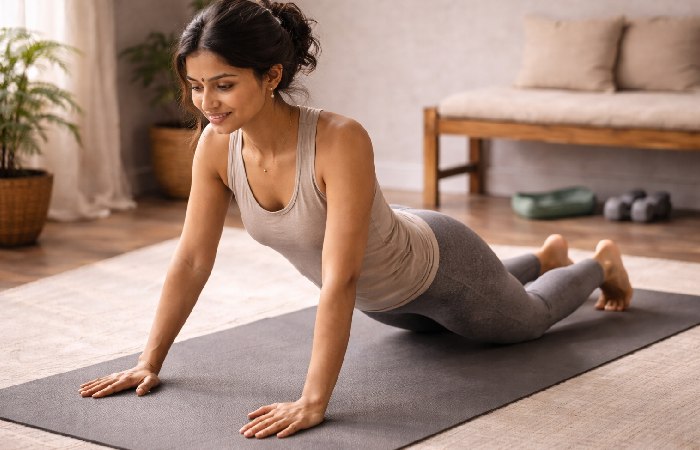
This phase builds the movement foundation. The goal is not to exhaust yourself — it is to establish consistency, correct basic movement patterns, and prepare your joints and connective tissue for higher-intensity work in the next training block.
Weekly Schedule Template
| Day | Session Type | Duration |
|---|---|---|
| Monday | Full-body strength (bodyweight) | 30 min |
| Tuesday | Low-intensity cardio (walk or cycle) | 25–30 min |
| Wednesday | Rest or gentle mobility | 15 min |
| Thursday | Full-body strength (bodyweight) | 30 min |
| Friday | Moderate cardio (brisk walk / light jog) | 30 min |
| Saturday | Active recovery (stretching, yoga) | 20 min |
| Sunday | Full rest | — |
Beginner Exercise List — Sets and Reps
Strength sessions (perform as a circuit, 2–3 rounds):
-
Bodyweight squats — 3 × 12
-
Modified push-ups (knees down if needed) — 3 × 8–10
-
Glute bridges — 3 × 12
-
Standing dumbbell rows (or resistance band rows) — 3 × 10
-
Plank hold — 3 × 20–30 seconds
-
Dead bug core exercise — 3 × 8 each side
Warm-up (5–7 minutes before every session): leg swings, arm circles, hip circles, marching in place, cat-cow stretch.
Guides from organisations such as the Mayo Clinic also recommend 5–10 minutes of lighter movement and dynamic stretching to prepare your muscles and joints before more intense exercise.
Cool-down (5–10 minutes after every session): standing quad stretch, seated hamstring stretch, pigeon pose, child’s pose, doorway chest stretch.
What Progress Looks Like at Week 4
By the end of this block, you should notice push-ups becoming easier, your resting heart rate a little lower, and post-workout soreness reduced compared to week one. This is the adaptation signal — your body is ready for more stimulus.
The Intermediate Home Fitness Routine (Weeks 5–12)

By this stage, true beginner-level workouts no longer provide enough stimulus for meaningful adaptation. This is when most people plateau — not because they are doing something wrong, but because their programme has not evolved.
The warm-up and cool-down protocol outlined in the beginner section applies at all training levels — do not skip it as intensity increases.
Introducing Progressive Overload at Home
This is the basic idea behind ALL effective training programs: overloading your muscles constantly over time (reps, sets, load, rest, exercise variation etc) so your musculature continues to adjust to the new level.
At home, you apply progressive overload through five mechanisms:
-
Increasing reps — from 10 to 12 to 15 per set.
-
Increasing sets — from 2 to 3 to 4 rounds.
-
Reducing rest time — from 90 seconds to 60 to 45.
-
Progressing the movement — from modified push-up → standard push-up → decline push-up.
-
Adding resistance — introducing bands or dumbbells where bodyweight no longer challenges.
Intermediate Weekly Schedule — Introducing Split Training
| Day | Session Type | Duration |
|---|---|---|
| Monday | Upper body strength (bands/dumbbells) | 40 min |
| Tuesday | Cardio intervals (HIIT or brisk walk/jog) | 25–30 min |
| Wednesday | Lower body and glutes | 40 min |
| Thursday | Active recovery or mobility | 20 min |
| Friday | Full body strength + core | 40 min |
| Saturday | Moderate cardio | 35–40 min |
| Sunday | Full rest | — |
Resistance Band and Dumbbell Incorporation
Upper body additions with bands or dumbbells:
-
Dumbbell shoulder press — 3 × 10
-
Resistance band pull-apart — 3 × 15
-
Dumbbell bicep curl — 3 × 12
-
Tricep overhead extension (dumbbell or band) — 3 × 12
Lower body additions:
-
Romanian deadlift (dumbbells) — 3 × 10
-
Banded lateral walk — 3 × 15 each direction
-
Bulgarian split squat (bodyweight or dumbbells) — 3 × 8 each leg
-
Banded glute bridge — 3 × 15
Supporting Your Routine With Food (Callout)
-
Aim for roughly 1.2–1.6 g of protein per kilogram of bodyweight per day to support muscle repair and growth.
-
Drink water regularly throughout the day, and especially before and after workouts, to support performance and recovery.
-
Eat a light pre-workout snack (for example, fruit plus some protein) 60–90 minutes before harder sessions to maintain energy.
-
Base your main meals around lean protein, whole grains, vegetables, and healthy fats to keep energy stable.
How to Revamp a Stale Home Fitness Routine
Revamping a home fitness routine means applying structured changes to volume, intensity, variety, or frequency — rather than starting over — to force new adaptation after a plateau.
This section is for people who have been training consistently but have stopped seeing results. A plateau after a few training blocks is normal — it is your body’s sign of adaptation, not failure.
The warm-up and cool-down protocol outlined in the beginner section applies at all training levels — do not skip it as intensity increases.
Signs Your Routine Has Stopped Working
-
Workouts feel noticeably easier than they did six to eight weeks ago.
-
Weight or body measurements have not changed in three or more weeks despite diet consistency.
-
You feel little or no muscle fatigue after sessions that used to challenge you.
-
Your motivation has dropped — partly because you are not seeing results.
The 4 Revamp Levers
Apply the same progressive overload principles covered in the intermediate section, using the four levers below.
-
Lever 1 — Volume: Add one additional set to each exercise, or add one additional training day.
-
Lever 2 — Intensity: Increase weight, choose a harder exercise variation, or reduce rest periods.
-
Lever 3 — Variety: Swap one or two exercises per session for different movements that hit the same muscle groups differently (secondary to volume and intensity changes).
-
Lever 4 — Frequency: Shift from full-body sessions to split training (upper/lower), or add a second session for a lagging area.
Before vs After Revamp — Sample Weekly Schedule
| Day | Stale Routine | Revamped Routine |
|---|---|---|
| Monday | Full body (same circuit) | Upper body strength — progressive overload applied |
| Tuesday | 30 min walk | HIIT intervals — 20 min |
| Wednesday | Rest | Lower body — split introduced |
| Thursday | Full body (same circuit) | Active recovery + mobility |
| Friday | 30 min walk | Full body strength — new exercise variations |
| Saturday | Rest | Steady-state cardio + core |
| Sunday | Rest | Rest |
Home Fitness Routine With Equipment — Making the Most of What You Have
Treadmill-Based Cardio Protocols
Rather than steady-speed walking, you can use interval protocols for greater cardiovascular and metabolic benefit in less time, adjusting all speeds to your fitness level and any medical advice you have.
-
Beginner interval: 2 minutes walk at an easy pace, 1 minute faster. Repeat 6–8 times.
-
Intermediate interval: 1 minute brisk, 1 minute easy. Repeat 8–10 times.
-
Advanced: 30 seconds at challenging effort, 90 seconds recovery. Repeat 8–10 times.
Resistance Band Full-Body Circuit
Perform each exercise for 45 seconds with 15 seconds rest. Complete 3 rounds:
Banded squat → Banded row → Banded push (standing chest press) → Banded deadlift → Banded lateral raise → Plank.
Dumbbell Strength Routine at Home
Three-day rotating split using dumbbells:
-
Day A (Push): Dumbbell press, shoulder press, tricep extension, lateral raise.
-
Day B (Pull): Bent-over row, bicep curl, single-arm row, rear delt fly.
-
Day C (Lower): Goblet squat, Romanian deadlift, lunges, calf raise.
No Equipment — Bodyweight Progression System
If you have no equipment, progression still follows the same principles using harder movement variations:
| Movement | Beginner | Intermediate | Advanced |
|---|---|---|---|
| Push pattern | Modified push-up | Standard push-up | Decline push-up |
| Squat pattern | Bodyweight squat | Jump squat | Pistol squat (assisted) |
| Hip hinge/glutes | Glute bridge | Single-leg bridge | Elevated hip thrust |
| Core | Plank 20 sec | Plank 45 sec | Plank with shoulder taps |
Staying Consistent — The Habit Architecture of Home Workouts

Motivation gets you started. Systems keep you going. Research on habit formation, including work led by Dr Phillippa Lally and others, suggests that habit automaticity takes on average around 66 days to develop — not the commonly repeated 21 days, and with substantial variation between people. In her discussion of this work, Dr Pippa Lally from the University of Surrey emphasises that while the average was 66 days, individuals in the original study took anywhere from 18 to 254 days to form a habit, showing how variable the process can be.
Your routine needs to be designed to survive long enough to become a habit.
Why Motivation Fails and What Replaces It
Motivation is emotion-dependent. It rises when you feel good and drops when you are tired, stressed, or busy — which is precisely when you need the routine most. The replacement for motivation is identity anchoring (“I am someone who trains three times per week”) and environmental design.
Environment Design — Making Your Space Work for You
-
Keep your yoga mat or equipment visible and accessible, not stored away.
-
Set a fixed workout time and protect it like a meeting.
In behavioural psychology, reducing friction — the small steps between intention and action — is one of the most reliable ways to make habits stick. Designing your environment so that exercise is the easiest option (and skipping requires more effort) supports consistency without relying on constant willpower.
Accountability Systems That Actually Work
-
Track every session in a simple notebook, spreadsheet, or app — completion creates momentum.
-
Share your weekly plan with one person who will notice if you skip.
-
Use implementation intentions: “I will work out on Monday, Wednesday, and Friday at 7 AM in the living room” — this kind of “if–when–where” plan significantly boosts follow-through.
Recovery — Why Rest Days Are Productive Days
Sleep and recovery are where your body actually adapts to the work you do.
-
Aim for about 7–9 hours of sleep per night to support muscle repair, hormone balance, and performance.
-
Rest days allow muscle protein synthesis and connective tissues to recover so you can come back stronger.
-
Watch for signs of overtraining: persistent fatigue, declining performance despite effort, and an elevated resting heart rate over several mornings — all cues to back off and recover.
How to Handle Missed Days Without Losing Momentum
Missing one session is normal. Missing two in a row is the beginning of a broken habit. The rule: never miss twice in a row. When you return after a missed day, do not attempt to compensate by doubling the session — just return to your scheduled workout as normal.
Tracking Progress Beyond the Scale
The scale is a single, easily misread data point. Strength training can increase muscle while you lose fat, so weight may stay the same while body composition improves. Without additional metrics, this can look like failure.
Metrics That Actually Signal Progress
| Metric | How to Track | How Often |
|---|---|---|
| Body measurements | Tape measure (waist, hips, arms, thighs) | Every 2 weeks |
| Strength benchmark | Max push-ups, squat reps at bodyweight | Monthly |
| Resting heart rate | Morning measurement, same time daily | Weekly average |
| Energy and sleep | Subjective 1–10 rating in a journal | Daily |
| Scale weight | Morning, post-bathroom, before eating | Weekly average |
Results Timeline — What to Expect
| Timeframe | What to Expect |
|---|---|
| Week 1–2 | Improved sleep and mood; soreness reduces as your body adjusts. |
| Week 3–4 | Measurable strength gains begin; daily energy often improves. |
| Week 6–8 | Visible body composition changes commonly start with consistent training and nutrition. |
| Month 3+ | Plateau risk rises — this is the time to reassess and apply the revamp levers. |
Free fitness tracking apps can simplify this process — any tool that logs your workout date, exercises, and sets or reps is enough.
When to Adjust Your Routine
Reassess and adjust roughly every training cycle. If two or more of these are true, it is time to change something:
-
Scale and measurements unchanged for three or more consecutive weeks.
-
Strength benchmarks not improving.
-
Energy levels declining despite consistent sleep.
-
Workouts feel too easy to complete.
Common Home Fitness Routine Mistakes to Avoid
-
Skipping warm-ups — see the beginner section for a simple warm-up that applies at every level.
-
Doing the same workout indefinitely — the Revamp section shows how to adjust volume, intensity, variety, and frequency.
-
Measuring success only by the scale — the Progress Tracking section explains better metrics to watch.
-
Going too hard too early. Excessive soreness and fatigue in week one leads to skipped sessions in week two; build progressively.
-
Not eating enough protein. Training stimulus without adequate protein means the muscle repair signal has limited raw material; the 1.2–1.6 g/kg/day range suits most active adults.
-
Neglecting recovery. Treat rest, sleep, and stress management as part of your plan, not an afterthought.
Final Verdict — What Actually Makes a Home Fitness Routine Work
The difference between a home training plan that works and one that quietly disappears is not willpower — it is structure, progression, and environment.
Start at your actual level. Apply progressive overload every training block. Use the equipment you have, not the plan written for someone with none. Track the right metrics. Protect two things above all else: consistency and recovery.
A well-designed home fitness routine built around these principles will usually outperform a gym membership used irregularly.
Frequently Asked Questions
How many days a week should I work out at home?
Three to five days per week is the optimal range for most adults, depending on your schedule and recovery. Beginners should start with three sessions, allowing full recovery between each; intermediate and advanced trainees can extend to four or five, provided at least one full rest day and one active recovery day are included.
Can I build muscle with a home fitness routine?
Yes — training at home builds muscle effectively when progressive overload is applied consistently and protein intake is around 1.2–1.6 g per kilogram of bodyweight per day. Bodyweight training builds muscle effectively up to an intermediate level; beyond that, added resistance through bands or dumbbells significantly extends your development ceiling.
How long before I see results from a home fitness routine?
Most people notice improved energy and sleep quality within two to three weeks. Visible body composition changes typically begin around weeks six to eight of consistent training, depending on nutrition and starting point, while measurable strength gains often appear within about four weeks.
Is a 30-minute home workout enough to see results?
Yes, for most fitness goals at beginner and intermediate levels. Thirty minutes of structured, progressive training three to four times per week consistently outperforms longer, irregular sessions; session quality and programme design matter more than duration.
What is the minimum equipment needed for an effective home fitness routine?
A yoga mat and a resistance band set are the minimum needed for a complete, progressive training plan at home. Dumbbells or an adjustable dumbbell set extend your strength progression ceiling further, and a treadmill or stationary bike can add structured cardio capacity — but bodyweight cardio and outdoor walking can serve the same function.
How do I know when to change my home fitness routine?
Change your routine — or apply the revamp levers (volume, intensity, variety, frequency) — when two or more of these apply: workouts feel noticeably easier than they did several weeks ago, measurements or weight have not shifted in three consecutive weeks, strength benchmarks have plateaued, or motivation has dropped significantly without an external cause. These are signs of adaptation, not failure.
Citation and Methodology
This guide is based on current recommendations from major health organisations and peer‑reviewed research, including global physical activity guidelines and evidence-informed advice on warm-ups, recovery, and habit formation. Exercise principles such as progressive overload, result timelines, and progression strategies are aligned with widely accepted strength and conditioning practice and cross-checked against reputable medical and fitness resources.
About Health4fitnessblog.com
Health4fitnessblog.com content is written to be practical and easy to understand across topics like health, technology, business, marketing, and lifestyle. Articles are based mainly on reputable, publicly available information, with AI tools used only to help research, organise, and explain topics more clearly so the focus stays on real‑world usefulness rather than jargon or unnecessary complexity.
Disclaimer
The information in this article is for general educational purposes only and is not a substitute for professional medical advice, diagnosis, or treatment. Always consult a qualified healthcare provider before starting, changing, or intensifying any exercise or nutrition programme, especially if you have any medical condition, are pregnant, or are taking medication.