Every cigarette you don’t smoke is already changing your body — starting 20 minutes from now.
That’s not motivation speak. It’s biology. The moment you stop inhaling tobacco smoke, your body launches a recovery process that begins with your heart rate and doesn’t stop for decades. Quit smoking benefits are measurable, progressive, and backed by decades of medical research.
But here’s what most guides won’t tell you: the benefits go far beyond your lungs. Quitting rewires your brain chemistry, restores proteins in your skin, and saves you thousands of dollars every single year.
This guide covers the complete timeline of what happens to your body when you quit smoking — from the first 20 minutes to 15 years and beyond. You’ll also find the science behind mental health recovery, financial savings projections, and skin restoration that most articles skip entirely.
Whether you’re thinking about quitting, already quit, or supporting someone through the process, this is for you.
Table of Contents
Quit Smoking Benefits at a Glance:
- When do benefits start? → Within 20 minutes — heart rate and blood pressure begin dropping toward normal
- What’s the biggest long-term benefit? → Heart disease risk halved at 1 year; lung cancer risk halved at 10 years
- Does mental health improve? → Yes — anxiety and depression typically decrease after the initial 2–4 week withdrawal period
- How much money will I save? → A pack-a-day smoker saves $3,000–$3,500+ per year in direct costs alone
- Is it too late to quit? → No — benefits occur at every age, even after 30+ years of smoking
What Are the Benefits of Quitting Smoking?
Quit smoking benefits are the measurable health improvements that begin within minutes of your last cigarette and continue accumulating for years. These benefits include reduced heart disease and cancer risk, improved lung function, better mental health, clearer skin, and significant financial savings.
What makes smoking cessation remarkable is the speed. Your body doesn’t wait weeks or months to start healing. The recovery process — what researchers describe as a cascade of physiological repair — begins almost immediately.
How Your Body Begins Healing Immediately

The first change happens before you even feel different. Within 20 minutes of your last cigarette, your heart rate starts dropping from its nicotine-elevated state back toward normal levels.
This happens because nicotine is a stimulant. Every cigarette artificially spikes your heart rate and constricts your blood vessels. Remove the stimulant, and your cardiovascular system begins recalibrating.
By the 12-hour mark, something critical happens in your blood. Carbon monoxide — a toxic gas you inhale with every puff — begins clearing out. Carbon monoxide binds to hemoglobin roughly 200 times more effectively than oxygen does. That means while you smoke, your blood carries less oxygen to every organ, every muscle, every cell. Within 12 hours of quitting, your blood oxygen levels start returning to normal.
The Science Behind Smoking Recovery
Your body’s repair process follows a predictable pattern that scientists call progressive tissue recovery. Different systems heal at different speeds, but they all follow the same principle: remove the toxin, and the body begins rebuilding.
Understanding this timeline is powerful. It turns an abstract decision (“I should quit”) into a concrete, trackable process (“my heart disease risk drops 50% at the one-year mark”). That shift from vague intention to measurable progress is what separates people who quit successfully from those who don’t.
Quit Smoking Benefits Timeline — From 20 Minutes to 15 Years
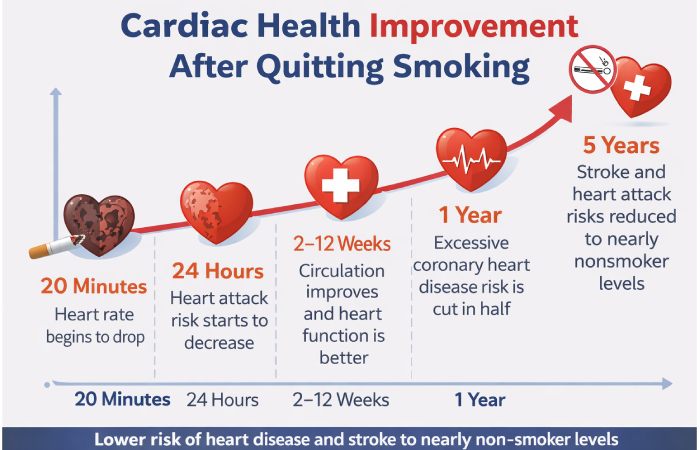
Here’s the complete body recovery timeline, backed by data from the CDC’s smoking cessation research and the World Health Organization’s tobacco fact sheet:
| Time After Quitting | Health Benefit | What’s Happening in Your Body |
|---|---|---|
| 20 minutes | Heart rate drops | Nicotine stimulant effect wears off; cardiovascular system begins normalizing |
| 12 hours | Blood oxygen normalizes | Carbon monoxide clears from blood; hemoglobin carries full oxygen again |
| 24 hours | Heart attack risk begins declining | Blood pressure stabilizes; clotting risk starts decreasing |
| 48 hours | Nicotine eliminated from body | Nerve endings begin regrowing; taste and smell start improving |
| 72 hours | Breathing becomes easier | Bronchial tubes relax and open; lung capacity increases |
| 2–12 weeks | Circulation improves significantly | Blood flows more freely; walking and exercise become easier |
| 1–9 months | Coughing and wheezing decrease | Cilia regrow in lungs; natural mucus clearance restored |
| 1 year | Heart disease risk halved | Coronary artery inflammation decreases; vascular function improves |
| 5 – 15 years | Stroke risk can match a non-smoker | Blood vessel diameter and function normalize |
| 10 years | Lung cancer risk halved | Precancerous cells replaced; abnormal cell growth slows |
| 15 years | Heart disease risk equals non-smoker | Cardiovascular system fully recovered from smoking damage |
The pattern is clear. Every milestone you reach compounds the one before it.
Immediate Benefits (20 Minutes to 72 Hours)
The first three days are where the most dramatic physiological changes happen — and ironically, where most people feel the worst.
Within 20 minutes, your heart rate and blood pressure start dropping. By 12 hours, carbon monoxide leaves your bloodstream and your oxygen levels climb back to normal. At 48 hours, nicotine is completely eliminated from your body.
That 48-hour mark is important. Your nerve endings begin regenerating, which is why many ex-smokers notice food tasting better and smells becoming sharper within the first few days.
Here’s what most people don’t expect: feeling worse during the first 72 hours is actually evidence that healing has started. Irritability, headaches, and cravings are withdrawal symptoms — signs that your brain is recalibrating to function without nicotine. They’re temporary. The recovery they signal is permanent.
Short-Term Benefits (2 Weeks to 9 Months)
Between two weeks and three months, your circulation improves significantly. Blood flows more freely to your extremities. Physical activities like walking, climbing stairs, and exercising become noticeably easier.
By the one-to-nine-month mark, a critical repair process kicks in: cilia regeneration. Cilia are tiny hair-like structures lining your airways. Their job is to sweep mucus, bacteria, and debris out of your lungs. Smoking paralyzes and destroys cilia, which is why smokers cough constantly — their lungs have lost their natural cleaning system.
When you quit, cilia begin regrowing. As they recover, your chronic cough fades, wheezing decreases, and your risk of respiratory infections drops significantly.
Long-Term Benefits (1 Year to 15+ Years)
At the one-year mark, your excess risk of coronary heart disease drops to about half that of a current smoker. This is one of the most significant milestones in the quit journey, and it applies to people with all smoking histories, although the absolute benefit is greatest the earlier you quit.
By 5–15 years, your stroke risk can fall to a level similar to someone who has never smoked. The risk of mouth, throat, esophageal, and bladder cancers is reduced by about half. The risk of mouth, throat, esophageal, and bladder cancers is reduced by half.
At 10 years, your risk of dying from lung cancer is approximately half that of a continuing smoker. Precancerous cells in your lungs are gradually replaced by healthy tissue.
At 15 years, your risk of coronary heart disease returns to nearly the same level as a lifelong non-smoker. According to the American Cancer Society’s cessation research, the risk of pancreatic and cervical cancer also continues declining during this period.
Heart and Cardiovascular Benefits of Quitting Smoking
Heart disease is the number one killer linked to smoking — and it’s also where quitting delivers the fastest, most dramatic results.
How Quitting Reduces Heart Attack and Stroke Risk
Smoking damages your cardiovascular system through three simultaneous mechanisms:
- Nicotine constricts blood vessels and raises heart rate
- Carbon monoxide reduces oxygen delivery to the heart muscle
- Tar and toxins promote inflammation and plaque buildup in arteries
When you quit, all three mechanisms begin reversing. Your blood vessels dilate, oxygen delivery improves, and arterial inflammation starts decreasing. Within one year, your excess heart disease risk is cut in half.
Blood Pressure and Circulation Recovery
Blood pressure begins dropping within 20 minutes of your last cigarette. But here’s the deeper benefit: over weeks and months, the chronic vessel constriction caused by years of nicotine exposure gradually relaxes.
Improved circulation means better blood flow to your hands, feet, and skin. Many ex-smokers notice warmer extremities, faster wound healing, and more energy within the first few months.
Lung and Respiratory Benefits After Quitting
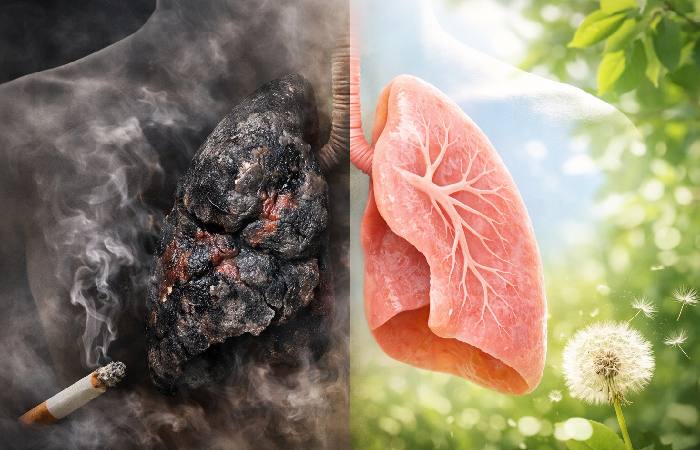
Your lungs take longer to recover than your heart — but the recovery is profound.
How Cilia Recovery Restores Lung Function
Think of cilia as your lungs’ built-in cleaning crew. In an active smoker, these tiny structures are flattened and paralyzed by toxic chemicals. Without functioning cilia, mucus and debris accumulate, creating the chronic “smoker’s cough.”
Within 1–9 months of quitting, cilia begin regenerating. As they regrow, your lungs can clear mucus normally again. The persistent cough fades. Shortness of breath decreases. Your lung function measurably improves.
One honest caveat: if you’ve smoked heavily for decades, some lung damage — particularly from COPD — may not fully reverse. Scarring from chronic obstructive pulmonary disease can be permanent. That said, quitting still slows disease progression dramatically and improves quality of life at every stage.
Cancer Risk Reduction Over Time
Lung cancer risk decreases steadily after quitting. At the 10-year mark, your risk of dying from lung cancer drops to about half that of a current smoker. Other smoking-related cancers — including mouth, throat, esophagus, bladder, kidney, and pancreatic cancer — also decline progressively.
The mechanism is straightforward: smoking causes DNA damage that leads to abnormal cell growth. When you stop exposing your cells to carcinogens, your body can repair damaged DNA and replace precancerous cells with healthy ones. The longer you stay smoke-free, the more complete this cellular renewal becomes.
Mental Health Benefits of Quitting Smoking
This is the section most quit smoking guides either skip or bury in a single sentence. That’s a mistake, because the mental health benefits are substantial — and widely misunderstood.
How Nicotine Hijacks Your Stress Response
Here’s a belief most smokers hold: “Cigarettes help me manage stress.” The reality is the opposite.
Nicotine creates an artificial dopamine cycle. Each cigarette triggers a short burst of dopamine — the brain’s reward chemical — followed by a rapid crash. That crash produces irritability, restlessness, and anxiety. The next cigarette “fixes” the crash, which reinforces the belief that smoking reduces stress.
But smoking didn’t solve the stress. It created the stress cycle in the first place.
When you quit, your brain’s natural dopamine and serotonin production gradually rebalances. The first 2–4 weeks can feel worse as your neurochemistry adjusts. After that adjustment period, most ex-smokers report lower baseline anxiety, fewer depressive episodes, and better concentration than when they were smoking.
Anxiety, Depression, and Mood Improvement After Quitting
Research consistently shows that quitting smoking is associated with reduced anxiety, depression, and psychological stress. In some studies, the improvement in mood is similar in magnitude to what is seen with antidepressant treatment.
This matters because fear of worsening mental health is one of the top reasons people avoid quitting — or relapse during withdrawal. Knowing that the initial mood disruption is temporary, and that long-term mental health improves, can be the difference between pushing through and giving up.
If you have a history of severe depression, bipolar disorder, or other serious mental health conditions, discuss your quit plan with a healthcare professional so your mood can be monitored and your support tailored to your needs.
Skin, Appearance, and Anti-Aging Benefits
Smoking ages your skin faster than almost any other external factor. The good news: much of the damage is reversible.
Collagen Restoration and Complexion Recovery
Smoking degrades collagen and elastin — the two proteins responsible for skin firmness and elasticity. It also constricts blood vessels in the outer layers of skin, starving it of oxygen and nutrients.
When you quit, circulation to your skin improves within weeks. Collagen production begins normalizing. Many ex-smokers notice a healthier complexion, reduced sallowness, and improved skin texture within 1–3 months.
While deep wrinkles from years of smoking may not fully disappear, quitting prevents further accelerated aging and allows your skin’s natural repair processes to function properly again.
Teeth, Hair, and Nail Improvements
The appearance benefits extend beyond skin:
- Teeth: Staining slows and stops; gum disease risk decreases significantly
- Hair: Reduced exposure to toxins can slow premature graying and hair thinning
- Nails: Yellow staining fades; nail strength improves
- Breath and scent: Clothes, hair, home, and car no longer carry tobacco odor
These changes are often the first benefits other people notice — which provides powerful social reinforcement during the quit process.
Financial Benefits of Quitting Smoking
The health benefits get most of the attention. But the financial impact is staggering — and consistently underestimated.
Annual Savings Calculation
The direct cost calculation is straightforward:
The examples below use an average US price of about 9 USD per pack for illustration; actual costs vary widely by country and state.
Cost per pack × Packs per day × 365 = Annual savings
| Smoking Rate | Pack Cost ($9 avg.) | Annual Savings | 5-Year Savings | 10-Year Savings |
|---|---|---|---|---|
| Half pack/day | $9.00 | $1,643 | $8,213 | $16,425 |
| 1 pack/day | $9.00 | $3,285 | $16,425 | $32,850 |
| 1.5 packs/day | $9.00 | $4,928 | $24,638 | $49,275 |
Hidden Costs Most Smokers Don’t Calculate
The price of cigarettes is only part of the equation. Smokers face additional financial burdens that most savings calculators completely ignore:
- Health insurance premiums: Smokers typically pay 15–50% more for life and health insurance
- Medical expenses: Smoking-related healthcare costs average significantly higher over a lifetime
- Home and auto maintenance: Smoke damage to upholstery, paint, and electronics adds cleaning and replacement costs
- Dental care: Higher frequency of gum disease, staining removal, and oral health treatments
- Productivity: Smoke breaks, increased sick days, and reduced energy carry real economic costs
When you factor in these hidden costs, the true financial benefit of quitting can be 2–3 times higher than the pack-price calculation alone.
Common Mistakes When Quitting Smoking
Understanding what goes wrong helps you avoid derailing your quit attempt:
- Expecting instant results. The benefits are real but progressive. Feeling worse in week one doesn’t mean quitting isn’t working — it means your body is actively withdrawing from nicotine.
- Confusing withdrawal symptoms with permanent changes. Irritability, brain fog, and increased appetite are temporary. They typically peak at 3–5 days and fade significantly by 2–4 weeks.
- Not using available support. Nicotine replacement therapy (NRT), prescription medications, quit hotlines, and behavioral counseling all significantly improve success rates. Trying to quit through willpower alone reduces your odds.
- For many people, combining behavioral support with medication offers the best chance of long-term success. Prescription treatments such as Champix (varenicline), along with options like Nicorette and other nicotine replacement therapies, can significantly reduce cravings and make withdrawal more manageable. If you’d like to explore a full range of treatment options to quit smoking, you can visit Pharmica’s online stop smoking service.
- Underestimating the mental health timeline. Many people relapse during the first 2–4 weeks because anxiety temporarily spikes. Understanding that this is a neurochemical adjustment — not a sign you need cigarettes — helps you push through.
- Ignoring triggers. Stress, alcohol, social situations, and habitual cues (morning coffee, driving) can trigger cravings months after quitting. Having a plan for these moments matters.
Who Benefits Most From Quitting — and When
Best for:
- Heavy smokers (20+ cigarettes/day): The greatest absolute risk reduction and the most dramatic health improvements
- Long-term smokers (20+ years): Significant life expectancy gains even after decades of smoking
- Young adults (under 40): Quitting before 40 reduces smoking-related mortality risk by approximately 90%
- Pregnant individuals: Dramatically reduces the risk of premature birth, low birth weight, and complications
- People with existing conditions: Even those already diagnosed with heart disease or COPD see meaningful improvements in disease progression and quality of life
Not for: Nobody. There is no age, health status, or smoking history where continuing to smoke is safer than quitting. The research is unequivocal on this point.
Important note: Even people over 60 gain significant benefits. Studies show that quitting at age 60 adds roughly 3 years to life expectancy. At age 50, the gain can be 6 years. The math always works in your favor.
Final Verdict — Why Quitting Smoking Is the Single Best Health Decision
The quit smoking benefits are not abstract or exaggerated. They are measured, documented, and begin within minutes.
Your heart starts recovering before you finish reading this article. Your blood oxygen normalizes overnight. Your cancer risk declines for years. Your brain chemistry rebalances. Your skin restores itself. Your wallet grows heavier.
No single health decision delivers this breadth of benefit — for this low a cost.
Practical recommendation: Start today. Not Monday. Not after this pack. Use evidence-based cessation tools — NRT, prescriptions, counseling, or a quit hotline. Track your timeline milestones. And know this: every failed attempt still teaches your body and your brain how to quit. The research shows that success rates increase with each attempt.
Your body is ready to heal. It’s been ready since your last cigarette.
Frequently Asked Questions About Quit Smoking Benefits
Q1: What happens to your body when you quit smoking?
Your body begins healing within 20 minutes — heart rate drops, blood pressure normalizes, and carbon monoxide clears from your blood within 12 hours. Over weeks and months, lung function improves, cilia regrow, circulation strengthens, and your risk of heart disease, stroke, and multiple cancers progressively declines. By 15 years, your heart disease risk matches a non-smoker.
Q2: How long does it take for lungs to heal after quitting smoking?
Lung recovery begins within 72 hours as bronchial tubes relax and breathing becomes easier. Cilia — the tiny cleaning structures in your airways — start regenerating within 1–9 months. Lung cancer risk halves at 10 years. However, permanent scarring from conditions like COPD may not fully reverse, though quitting still slows progression significantly.
Q3: Is it too late to quit smoking at 50 or 60?
No. Quitting at age 50 can add approximately 6 years to life expectancy. Quitting at 60 adds roughly 3 years. Research shows that quitting before age 40 reduces smoking-related mortality risk by approximately 90%. Benefits occur at every age, regardless of how long you’ve smoked.
Q4: Does quitting smoking improve anxiety and depression?
Yes. After an initial adjustment period of 2–4 weeks, most ex-smokers experience lower baseline anxiety, fewer depressive episodes, and improved concentration. This happens because quitting allows your brain’s natural dopamine and serotonin systems to rebalance after nicotine disruption.
Q5: How much money do you save by quitting smoking?
A pack-a-day smoker at average U.S. prices ($9/pack) saves approximately $3,285 per year. Over 10 years, that’s nearly $33,000 — before factoring in reduced insurance premiums, lower healthcare costs, and decreased home maintenance expenses, which can double or triple the total savings.
Q6: What are the hardest days after quitting smoking?
Days 3–5 are typically the most intense, as nicotine withdrawal peaks and cravings are strongest. Symptoms include irritability, headaches, increased appetite, and anxiety. These withdrawal effects are temporary and usually diminish significantly by weeks 2–4. Using nicotine replacement therapy or prescription cessation aids can substantially reduce withdrawal severity.
Disclaimer
This content is for general information only and is not a substitute for professional medical advice, diagnosis, or treatment. Always consult a qualified healthcare provider with questions about your health, medications, or quitting smoking, and never disregard or delay seeking medical guidance because of something you read here. Use of this information is at your own risk, and no liability is accepted for actions taken or not taken based on this content.