When it‘s a loved one, and that loved one is battling addiction, it‘s every day in one combination of fear, frustration, and hope that something will change. You‘ve likely worn yourself down all available intervention an angry talk, tearful begging, ineffective ultimatums that fall apart before sunlight. The trap of your own words paralyzes you, and silence has failed you also.
If there is an urgent situation involving imminent danger for example, overdose risk, life threatening self harm or violence omit all intervention planning and call emergency services or a crisis line immediately. Planned interventions should only be used when there is no urgent life threatening emergency but the pattern is clearly unsustainable.
A formal intervention offers a structured path forward. When led with professional guidance and careful preparation, some professional intervention organizations report that around 80–90% of professionally led interventions result in the person agreeing to enter a treatment program, when “success” is defined as entering treatment, not long‑term recovery. These outcomes are not guaranteed and depend heavily on planning, follow‑through, and the quality of care that comes afterward.
This comprehensive guide will show you step-by-step how to plan and execute a successful intervention what are the various intervention models, how do you assemble your team, what should you say (and not say), and what you do if your loved one refuses treatment. These are the proven intervention tips that can make sure your intervention is a success whether you’re hiring a professional interventionist or holding it on your own with family.
For family and friends who have accepted that they do not want to wait for the problem to go away.
Table of Contents
Quick Answers
- What is an intervention?-> A series of purposely organized structured encounter where family and friends show the consequences of addiction and present an agreed upon treatment strategy.
- Do interventions work? -> Some of the intervention packages used by professional intervention organizations say they successfully lead 80–90% of the persons they target to enter treatment but as far as longterm recovery goes, what happens afterwards is what counts.
- What is the most common mistake? -> Visiting the dark side without any plan or professional guidance.
- Which one is best for my family? -> It depends on time, fidelity, and style see the Johnson, ARISE, and CRAFT models below.
- What if they refuse? → Hold your boundaries. Even when people initially refuse, some go on to accept treatment later — sometimes within days or weeks of the intervention.
What Is an Intervention?

An intervention is a preplanned, highly organized face-to-face meeting, led by a therapist or counselor and attended by family members and close friends, that brings to light tangible evidence the addict‘s substance use has negatively impacted the lives of those he or she loves. An intervention provides a clear course of action toward treatment.
This isn‘t an attack that is meant to shame or punish. This is a well-coordinated, strategic installation that reads: this cannot go on; here‘s where we can go from here.
How Interventions Work (The Core Mechanism)
Addiction changes the brain’s reward system and decision-making circuitry. People struggling with substance use disorders genuinely may not recognize the severity of their situation — this isn’t stubbornness, it’s a feature of the disease itself.
An intervention disrupts that pattern by making the situation impossible to dismiss. When four or five people your loved one genuinely respects sit in the same room — each calmly presenting specific, undeniable evidence — the usual deflections stop working. A ready treatment plan removes the “I don’t know where to go” excuse. And clearly stated consequences show what continuing looks like, in terms the person can feel.
That said, an intervention is not a magic bullet. It’s the beginning of a process, not a cure.
Types of Addiction That May Require an Intervention
Interventions aren’t limited to alcohol or street drugs. According to Mayo Clinic’s guide to intervention planning, situations that may warrant an intervention include:
- Alcohol use disorder
- Prescription drug misuse
- Illicit drug use
- Compulsive gambling
- Compulsive eating disorders
- Behavioral addictions (gaming, shopping, pornography)
What all five have in common: the action has become repetitive, it‘s doing tangible damage and the individual either isn‘t aware that there‘s an issue or is unwilling to take proactive steps.
Types of Intervention Models Compared
Indeed, most guides tend to treat interventions as a one size fits all. They are not. There are three well known models to fit an intervention to a given situation and picking the right one for yours can make a real difference.
The Johnson Model (Traditional / Surprise-Based)
The term intervention is generally associated with this type of intervention, developed by Vernon Johnson in the 1960‘s. It involves family and friends who organize a team to confront an addict without their knowledge about the severity of their addiction and threaten treatment there and then.
Best for: Urgent situations if the client‘s in active crisis or if prior attempts to communicate have failed totally or if time is limited to get the client into a treatment bed.
Risk: The very nature of a surprise might prove an attack. If the client is very defensive or insecure, the result might be complete withdrawal.
The ARISE Model (Invitational / Graduated)
Developed by Dr. Judith Landau, ARISE (A Relational Sequence for Engagement) takes the opposite approach from Johnson. There are no secrets. The individual is invited into the process from the very first conversation.
ARISE uses a graduated three-level system:
- Level 1 (The First Call): A professional discusses with the family the possibility of providing support initiation8.
- Level 2 (Strength in Numbers): Family meetings that include the patient, motivating him/her to treatment
- Level 3 (Formal intervention): a session arranged only when Level 2 is deemed unsuccessful
It is most suitable: With families who want to hold on to trust and transparency, situations where the relationship is not too damaged, and with people who deal better with working as a team rather than a battle.
Time: This method will take longer due to the graduated timeline. It may be inappropriate when there is a time constraint requiring quick action.
CRAFT (Community Reinforcement and Family Training)
Unlike Johnson and ARISE, CRAFT is an evidencebased, behavioral approach that has been developed from research support by the National Institute on Drug Abuse. CRAFT is not a one time intervention, but instead teaches family members specific skills in communication and behavior that:
- Strengthen the individual‘s sober behaviors (increase the positive outcomes of sobriety)
- Allow natural consequences for substance use (stop enabling)
- Enhance your family member‘s own well-being
- Slowly bring the person‘s motivation towards the treatment.
Best for: Families of treatment refractory cases, when there is a perception that an exploratory formal intervention is a risk too far and when the family member wishes to re-establish a feeling of control and enhance their own mental health irrespective of the result.
Risk: Involves being persistent on a weekly/monthly basis. There is no fixed point where you have got there, instead you are encouraged to remain consistent.
Intervention Models at a Glance
| Feature | Johnson Model | ARISE | CRAFT |
|---|---|---|---|
| Core Style | Confrontational / Surprise | Invitational / Collaborative | Behavioral / Skill-based |
| Individual Included From Start? | No | Yes | N/A (no formal meeting) |
| Confrontation Level | High | Low–Medium | None |
| Timeline | Single meeting | Weeks (graduated) | Weeks to months |
| Primary Goal | Immediate treatment entry | Voluntary engagement | Behavior change + treatment motivation |
| Family Focus | Medium | High | Very High |
| Evidence Base | Clinician-established (1960s) | Research-supported | Strong peer-reviewed evidence (NIDA-funded) |
| Best When… | Crisis requires immediate action | Relationships are intact; trust matters | Formal intervention feels too risky or has failed |
How to choose: For time critical or dangerous situations the Johnson Model with professional Interventionist would be recommended. For long term family healing, ARISE might be better to make sure relationships are healthy. If a formal confrontation is inappropriate for your family or you‘d like to ease into it, CRAFT offers tools to alter the system without ever having the first (or third) meeting.
How to Plan a Successful Intervention Step by Step
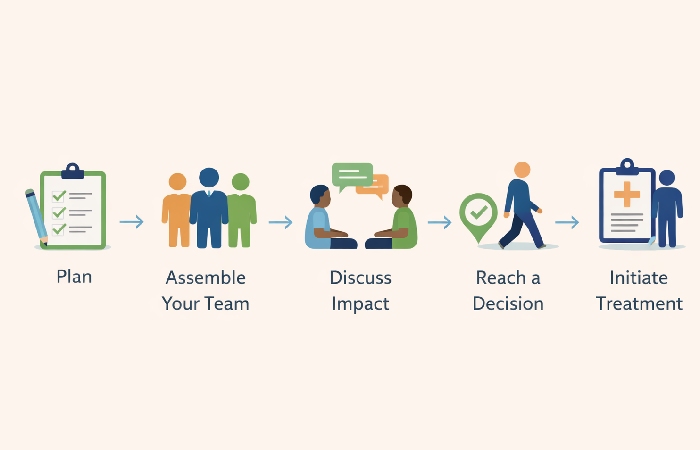
Preceding planning is what distinguishes between a successful intervention and one that does harm. Having to hurry to get this stage done is the most common reason for intervention failure.
Step 1 — Consult a Professional
Go Ask for Help First! Talk to someone who can help before you do anything else. This might be a licensed psychologist, a licensed addiction counselor, a certified interventionist or a social worker experienced with addiction.
- A professional brings three things you can‘t replicate on your own:
Objectivity They“re not emotionally caught up in the situation. - Structure They know how to manage the meeting in a way that is productive and on- track.
- Safety management They‘re trained in volatile reactions
This step is especially critical if your loved one has a history of violence, severe mental illness, suicidal ideation, or is using multiple substances. Families can contact SAMHSA’s National Helpline at 1-800-662-4357 for free, confidential, 24/7 guidance on finding local professionals and treatment options.
Step 2 — Assemble Your Intervention Team
You need 4 to 6 people. Not a crowd — a small, deliberate group of people your loved one genuinely cares about. A parent. A sibling. The friend who’s known them since college. A trusted mentor or faith leader. The key is relationship quality, not quantity.
Do not include anyone who:
- Has an unmanaged substance use problem themselves
- Is likely to become aggressive, overly emotional, or go off-script
- Has a hostile or deeply strained relationship with the individual
- Might sabotage the process (sometimes an enabling family member, even with good intentions, can undermine the team’s message)
Here’s the part most guides skip: one family member can derail the entire intervention. If someone on the team can’t commit to enforcing boundaries — or is likely to break down and tell the person “you don’t really have to go” — it’s better to have them write a letter that someone else reads aloud.
Step 3 — Research Treatment Options
Have a specific, actionable treatment plan ready before the intervention. Not “we think you should get help.” An actual plan:
- Which facility or program (inpatient, outpatient, detox, assessed-based placement)
- Whether a bed/slot is available and confirmed
- How insurance or payment will be handled
- Transportation logistics
- Any immediate needs (child care, pet care, work notification)
If inpatient care is appropriate and your family can afford it, you may also consider high-amenity or luxury treatment centers that offer more privacy and comfort alongside clinical services. The key is still medical quality and fit for your loved one’s needs, not just the setting.
The moment your loved one says “okay” — and that moment can be fleeting — you need to be ready to act. Hesitation gives denial time to reassert itself.
Step 4 — Write Impact Statements
This is not the place for improvisation. Each person on the team writes down — in advance, on paper — exactly how the addiction has affected them personally. Not a rant. Not a eulogy. A focused, rehearsed message that’s been thought through and practiced.
The formula that works:
- Start with an expression of love or care
- Give details of an incident or activity that took place (be specific and to the point) Show you are aware of behavior or incident and that this is not a general comment.
- Describe the emotional effect by using “I” statements such as (“I felt scared when…” rather than “You made me feel scared…”).
- Finish by asking for something. “I‘m asking you to accept this help today”
Keep each statement under 3 minutes. The intervention should feel focused, not like a marathon of grievances.
Step 5 — Rehearse the Intervention
This step feels awkward, and families often skip it. Don’t.
Run through the entire intervention at least once with all team members. Decide:
- Who takes the lead at the beginning and end (sometimes the most prominent, cool voices will give coherence to the meeting)
- What happens if the person attempts to leave:
- An individual plan of how the team is going to respond to particular deflections (“I can walk out on my own,” “I am not a problem,” “You‘re all ganging up on me”)
- Who presents the treatment plan
- Who states the consequences
Rehearsal also reveals weak links — team members who may fold under pressure or stray from the plan.
Step 6 — Choose the Right Time and Place
- Timing: When is the person most likely to be sober, rested, and not in great crisis? If possible, try to do the intervention in the morning. Do not do an intervention when the patient is intoxicated, as they are unable to process the information you are providing to them, and it increases the chance of blow-up.
- Location: (a private, neutral, comfortable environment (not a restaurant, public area, and not where the other person may associate the person with intimidating, conflict-creating situations. A living room, a counselor‘s office, or an empty conference room (is ideal.
Step 7 — Conduct the Intervention
Follow the plan. Read your statements. Stay calm. The individual will likely react with some combination of denial, anger, bargaining, and sadness — sometimes all of them within minutes.
Key ground rules during the meeting:
- Send the same message. The same team message.
- Don‘t argue. Even when debated or sidetracked, patiently speak again with thesame script.
- Say no to manipulation.“I‘ll take care of it myself” or “if only you would give me one more chance” are denial patterns and not ready-to-go.
- Keep it for 80-90 minutes. If goes on longer, the emotional energy drops attention wavers.
Step 8 — Be Ready for Immediate Action
If they agree — move immediately. Drive to the facility. Help them pack. Don‘t delay until tomorrow. The willingness window may snap shut quickly. An empty bag, pre-verified insurance, and travel arrangements cut down all the pain points of going from “yes” to in the door.
What to Say During an Intervention (And What to Avoid)
Using “I” Statements Effectively
“I” statements can keep the tone more personal and less accusing. They are also less able to be argued by the other person, since you are just explaining yourself rather than making generalizations about them.
Effective examples:
- “I‘m scared whenever the phone rings at night, because I think something‘s happened to you.”.
- I love you and I have watched you become someone I hardly recognize. That‘s why I‘m here.
- ‘I can‘t keep acting like this is okay. You need to realize how much this has ruined our family.’
Words and Phrases That Sabotage Interventions
Certain language patterns trigger defensiveness and shut down communication. Avoid:
Labels: “You‘re an addict,” “You‘re an alcoholic” these will generate shame, not motivation.
- Absolutes “You always…”“You never…”“very easily challenged”
- Great targets for proof against; the most effortless path to derail the whole conversation.
- Threats disguised as consequences: There’s a line between a boundary and a threat, and tone is what separates them. “If you don’t go, I’m done with you” — that’s a threat. “I love you, and I can’t keep paying for something that’s hurting you” — that’s a boundary. Both describe the same action. The difference is whether your loved one hears anger or care.
- Guilt trips: “After everything I’ve done for you…” shifts focus from their recovery to your sacrifice
- Comparisons: “Your sister never had this problem” — shaming by comparison destroys trust
Common Intervention Mistakes That Cause Failure
Even well-intentioned interventions fail when families fall into predictable traps. Watch for these:
- No professional guidance. Families often believe they can handle it alone. The emotional complexity of addiction makes this risky — a trained interventionist keeps the process structured and safe.
- Doing it impulsively. An outburst ignited by a splash of rage is not an intervention. Its an argument. Interventions take weeks of preparation.
- Having the wrong people present. One combustible or enabling person can unravel hours of preparation. Select the right people to be present those who can manage the issue calmly and stick to the plan, not merely soothe the individual.
- Not having a treatment plan prepared. Telling someone “you need help,” but failing to give them a program, admission date, and logistics is like diagnosing a problem without providing a solution.
- Approaching them drunk. The drunk individual will not remember you as having this conversation; they will not be able to comprehend the emotion with which it was spoken, and you‘re more likely to receive hostility.
- Say consequences that you really won‘t follow through on. If you‘ll take away or reduce their material needs, mean it don‘t reaffirm when they call a week later that you‘ll still pay their phone bill. This way, they learn that you‘ll fudge your own boundaries.
- Turning it into a venting session. This session is not an opportunity for you to vomit your accumulated anger. Each thing you say should have one goal in mind to motivate the individual to sign up for treatment.
What Happens If They Refuse Treatment?
This is the question that frightens families most — and it happens. Not every intervention ends with a “yes.”
Setting and Enforcing Boundaries
If your loved one does not accept treatment, each member of the team must follow through on the consequences they told the patient during the intervention. This is not punishment but self-preservation and a refusal to continue enabling the addiction.
Common boundaries include:
- Stopping financial support
- No longer making excuses to employers, friends, or other family members
- Asking the person to find alternative living arrangements
- Limiting contact until they’re willing to accept help
Following through is the hardest part of the whole shebang. There are support groups out there, like Al-Anon and Families Anonymous. that are designed to help the family members do right by those lines of boundaries guilt free.
Why Many People Accept Help After the Intervention
This is the part that families need to hear most: “a no today is not a no forever.” A good number of those who decline treatment during the intervention are willing to enter a program at a later time: sometimes a few days, sometimes a few weeks, down the road. The intervention plants a seed. When combined with enforced boundaries — when the enabling stops — the reality of the situation becomes harder to ignore.
Stay firm. Stay available. And keep the treatment option open.
When to Hire a Professional Interventionist
Situations That Require Professional Guidance
Although some families can implement interventions on their own, it is advisable to consult a professional for most families and absolutely necessary when:
- Has a history of violence or aggressive behavior.
- A known or suspectedco-morbid mental illness (depression, bipolar disorder, PTSD, personality disorder)
- The individual presents with expressesuicidal ideationor has a history of self-harm
- They are using a sort of mixture
- Previous informal conversations or intervention attempts have failed
- The family dynamics are highly conflicted or there’s a history of trauma within the family
How to Find a Qualified Interventionist
Look for someone with recognized credentials:
- Credentialed by agencies such as the Association of Intervention Specialists (AIS) or the National Association of Addiction Treatment Providers (NAATP)
- Licensedas a counselor, social worker, or psychologist in their state
- Prepared to give references and to discuss their method
According to industry statistics gathered by professional intervention programs, interventionist fees tend to range from $1,500-$10,000 or more depending on the severity of the problem, travel needs, and the level of intervention required. For families unable to pay for professional intervention services, SAMHSA‘s National Helpline (1-800-662-HELP) offers free, confidential referrals to local treatment facilities, support groups, and community organizations.
Follow-Up and Aftercare: The Part Most Guides Skip
The intervention itself is one moment. Recovery is a long road — and the family’s role doesn’t end when the person enters treatment.
The Critical First 72 Hours
If your “buddy” accepts treatment, many treatment experts report the highest-risk window for reverting to your drug of choice is during this first 72 hours. Keep the difference between “yes” and treatment to the minimum:
- Have transportation ready immediately
- Pre-pack the essentials (or assist them in packing efficiently)
- Support communication, but keep in short longer communication can bring the doubt back.
- Do not alter the terms of treatment. During this window, there should be no renegotiation!
Family Support and Recovery
Addiction doesn’t happen in isolation, and recovery doesn’t either. Families need their own support:
- Family therapy: Many programs include family appointments, so be sure to play an active role.
- Support groups: Al-Anon, Families Anonymous and Nar-Anon offer structured support groups in which other families who are experiencing addiction can be a source of peer support.
- Personal counseling: You‘ve been carrying a great deal. A counselor can help you come to terms with that and do it not just for the person you lost, but for yourself.
- Relapse education: The National Institute on Drug Abuse cite figures indicating that 40% to 60% of people with substance use disorders relapsed following treatment. This rate compares favorably with relapse rates for other chronic conditions such as diabetes or hypertension. That comparison matters. Nobody says diabetes treatment “failed” because a patient needs their medication adjusted. The same logic applies here: relapse is a signal to adjust the approach, not evidence that the effort was wasted.
Who Should Consider an Intervention — and Who Should Wait
An intervention is appropriate when:
- Attempts informal discussions about the issue, which have been ineffective from creating change
- The addiction is responsible for tangible, quantifiable negative consequence (health, personal relationships, finances, work, legal 6.7k)
- You have identified a specific treatment program and can present it as an option
- You can assemble a calm, committed team willing to maintain stated boundaries
- A professional has been consulted (or is leading the process)
An intervention is NOT appropriate when:
- The individual is violently active, psychotic episode. Dial 911 or local emergency service
- The patient is intoxicated or in withdrawal; wait until the patient is sober.
- No treatment plan has been arranged — an intervention without a solution creates despair, not motivation
- The team includes members who cannot commit to enforcing stated boundaries
- Main objective is to punish or vent anger rather than caring about the person‘s well being
If you or someone you know is in immediate danger or experiencing a mental health crisis, call or text the 988 Suicide & Crisis Lifeline or your local emergency services.988 Suicide & Crisis Lifeline or your local emergency services.
Final Verdict
A successful intervention is not an ambush, a confrontation, or a last-ditch effort that is driven by desperation. It‘s a thoughtful, research-based process that provides your loved one with the best chance possible for moving from denial to treatment.
Really significant steps: employ or get a professional to do the work, select the proper type of intervention based on the circumstances, create a concrete treatment alternative in advance of the meeting, practice with your team and ready to act immediately your loved one agrees.
What if they say no. Stick to your guns. Keep yourself present. The work is still important-it‘s planting a seed that frequently grows in the days and weeks that come.
This is difficult. It may be one of the most difficult things you‘ve ever had to go through. But not doing anything certainly isn‘t going to be easier and you‘ve already been paying for it.
So what should you do next? If you have no idea where to turn, contact the FREE, confidential 1-800-662-HELP (4357) from SAMHSA, the Substance Abuse and Mental Health Services Administration. Call 24 hours a day, year-round for guidance. Talk to a well-trained information specialist to locate a professional interventionist, treatment programs, and additional resources in your area whatever your financial situation.
Need Help Now? Free, Confidential Resources
- SAMHSA National Helpline: 1-800-662-4357 (free, 24/7, 365 days/year)
- 988 Suicide & Crisis Lifeline: Call or text 988
- FindTreatment.gov: Find treatment programs near you
- Al-Anon Family Groups: al-anon.org — Support for families affected by someone’s addiction
These resources are free and available to anyone, regardless of insurance or ability to pay.
Frequently Asked Questions
Q: Do interventions actually work?
A: According to the National Council on Alcoholism and Drug Dependence, over 90% of professional intervention resulted in the person agreeing to treatment. But, ‘success’ at this stage means agreement to treatment… Long-term recovery is a matter of continued effort, good treatment, good support and aftercare.
Q: How long should an intervention last?
A: Interventions should be 60-90 minutes in duration. Any longer then this and emotional exhaustion is reached, and the process loses focus. Remember impact statements should be brief, and no longer than 3 minutes.
Q: What do you say during an intervention?
A: Use “I” statements to describe specific incidents and their emotional impact (“I felt scared when…”). Express love and concern first. Present the treatment plan clearly. State your personal boundaries calmly. Avoid labels (“addict”), accusations (“you always…”), and guilt trips.
Q: What if the person refuses treatment after an intervention?
A: Follow through on whatever boundaries that you set at the beginning. In reality, most who initially refuse treatment will then accept help one to two weeks down the road when the enabling is reduced. Stick to your boundaries and be prepared to help them when they are ready.
Q: Should children attend an intervention?
A: By and large, no. No children under 18 should be present during the intervention. The emotional intensity may be too overwhelming (or damaging). Their written statement read by an adult (if clinically appropriate) may be included.
Q: How much does a professional interventionist cost?
A: The fees can be from $1,500 to $10,000 or more, depending on the severity of the situation, the travel involved, and the duration of intervention. For those families who may not have been able to pay for professional services, the SAMHSA National Helpline (1-800-662-4357) offers free referral sources to local agencies.
This article contains tips and advice for information purposes only. It is not intended to be used for medical, psychological or professional advice. Addictions interventions can involve many complex family issues and potential safety hazards. Before planning an intervention, you should always consult a qualified professional such as your professional interventionist, addiction or mental health professional/litigator. If you are or anyone you know is in immediate danger, call 911 or the 988 Suicide & Crisis Lifeline.