Feeling stiff, stressed, or stuck in a fitness rut? A yoga routine might be exactly what you need. Unlike sporadic stretching sessions, a structured yoga routine is a planned sequence of poses performed regularly to systematically improve flexibility, build strength, and cultivate mental clarity.
Whether you’re completely new to yoga or looking to establish a consistent home practice, this guide breaks down everything you need: beginner-friendly sequences, goal-based customization strategies, realistic progression timelines, and the most common mistakes to avoid.
By the end, you’ll know exactly which routine matches your goals, how to perform it correctly, and what to expect week by week.
Table of Contents
Quick Summary
- Looking for a yoga routine? → Structured sequences improve flexibility, reduce stress, and build strength through regular practice
- Complete beginner? → Start with 5-10 minute routines using basic poses like Child’s Pose, Cat-Cow, and Downward Dog
- Want specific results? → Customize routines based on your primary goal (flexibility, strength, or stress relief)
- How often should you practice? → 3-5 times per week for noticeable results within 3-4 weeks
- Worried about doing it wrong? → Focus on the 5 essential poses and avoid the 3 most common mistakes (skipping warm-up, holding breath, pushing too hard)
What Is a Yoga Routine?
Definition and Components
A yoga routine is a structured sequence of yoga poses (asanas) performed in a specific order, typically combined with breathing techniques (pranayama). It can range from 5 to 60 minutes and is designed to improve flexibility, build strength, reduce stress, and enhance overall well-being through regular practice.
According to the National Center for Complementary and Integrative Health (NCCIH), yoga is a mind-body practice that typically includes physical postures, breathing exercises, and meditation or relaxation. NCCIH notes that research suggests yoga may help with stress management, mental and emotional health, healthy activity habits, sleep, and balance, although findings are not yet definitive for every condition.
Most yoga routines include three core components:
- Warm-up poses – Gentle movements to prepare muscles and joints (Cat-Cow, gentle twists)
- Main sequence – The primary poses targeting specific benefits (strength, flexibility, balance)
- Cool-down/relaxation – Restorative poses and final relaxation (Corpse Pose, deep breathing)
Types of Yoga Routines
Yoga routines can be categorized by timing, intensity, or goal:
By Time of Day:
- Morning routines – Energizing sequences to wake up the body (Sun Salutations, standing poses)
- Evening routines – Calming practices for relaxation and better sleep (forward folds, restorative poses)
By Goal:
- Flexibility-focused – Longer holds in stretching poses (5-8 breaths per pose)
- Strength-focused – Dynamic flows and challenging holds (planks, warriors, arm balances)
- Stress-relief focused – Gentle, restorative poses with emphasis on breathing
By Style:
- Hatha routines – Slower-paced, holding poses longer
- Vinyasa routines – Flow-based, linking breath with movement
- Restorative routines – Passive poses held for extended periods
Benefits of a Daily Yoga Routine
Physical Benefits
Flexibility Improvement
Regular yoga practice progressively lengthens muscles and connective tissue. Studies show that flexibility can improve over several weeks of consistent yoga, with some research reporting meaningful gains after about 8–10 weeks of practice.
Strength Building
Yoga uses bodyweight resistance and isometric holds to build functional strength. Poses like Plank, Warrior sequences, and Boat Pose engage multiple muscle groups simultaneously, improving core stability and overall body strength. According to research from Harvard Medical School, participants practicing yoga twice weekly for eight weeks experienced substantial improvements in muscle strength and endurance, comparable to traditional resistance training for beginners.
Posture Enhancement
Many yoga poses strengthen the muscles supporting your spine while stretching tight areas (chest, hip flexors). This creates better postural alignment and reduces strain from prolonged sitting. A study published in the journal Spine found that participants who practiced yoga twice weekly for 24 weeks experienced a 56% reduction in back pain and significant improvements in posture-related disability.
Mental Benefits
Stress Reduction
Yoga activates the parasympathetic nervous system through controlled breathing and mindful movement. A comprehensive meta-analysis of 42 randomized controlled trials published in Psychoneuroendocrinology found that yoga interventions were associated with significant reductions in evening cortisol levels, waking cortisol, and ambulatory systolic blood pressure compared to control groups. The research demonstrates that yoga helps regulate stress by modulating the hypothalamic-pituitary-adrenal (HPA) axis, which controls your body’s stress response.
Improved Focus
The concentration required to hold poses and coordinate breath with movement trains mental focus that extends beyond your practice session. Research from Harvard Health Publishing indicates that yoga practitioners develop greater body awareness and mindfulness that transfers to other areas of life, improving decision-making and concentration.
Better Sleep Quality
Evening yoga routines, particularly those emphasizing gentle stretches and breathing exercises, can improve sleep quality by calming the nervous system before bed.
How Long Until You See Results?
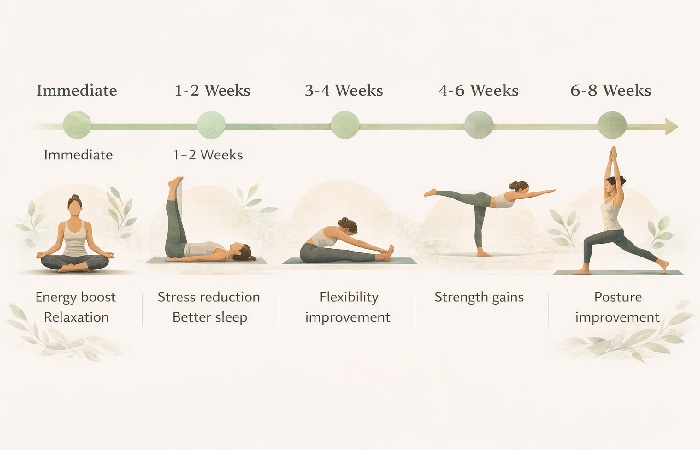
Realistic timelines for different benefits:
- Energy boost – Immediate (same session)
- Stress relief – 1-2 weeks of consistent practice
- Flexibility improvements – 3-4 weeks (noticeable), 8-12 weeks (significant)
- Strength gains – 4-6 weeks
- Posture changes – 6-8 weeks
- Weight management support – 8-12 weeks (combined with diet)
Consistency matters more than session length. In practice, short daily sessions (around 10 minutes) usually lead to better progress than doing a long session only once a week.
The 5 Essential Poses Every Yoga Routine Must Include
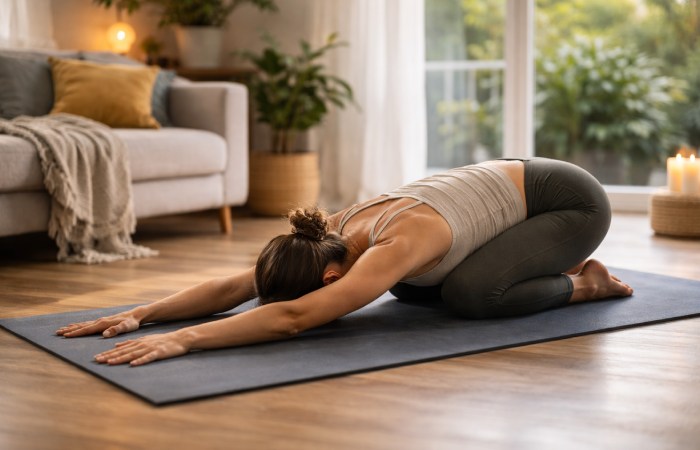
These foundational poses appear in nearly every effective yoga routine because they address the body’s primary movement patterns and needs.
Child’s Pose (Balasana)
What it does: Gently stretches the lower back, hips, thighs, and ankles while promoting relaxation.
Why it’s essential: Serves as a resting position between more challenging poses and provides a safe way to release lower back tension.
How to do it:
- Kneel on your mat with big toes touching
- Sit back on your heels
- Fold forward, extending arms in front or resting them alongside your body
- Rest forehead on the mat
- Hold for 5-10 breaths
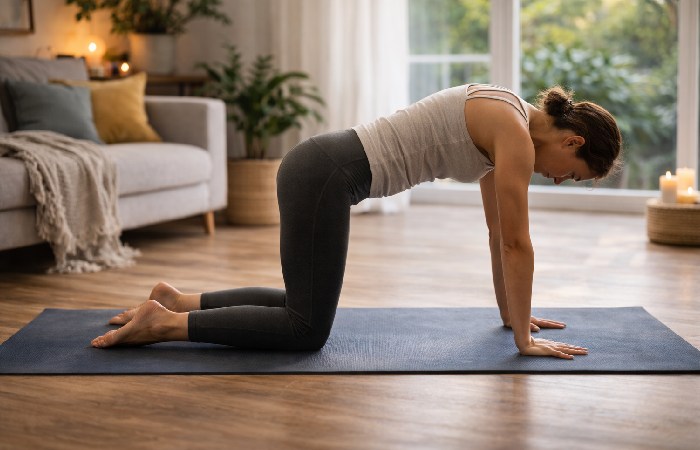
Cat-Cow (Marjaryasana-Bitilasana)
What it does: Warms up the spine, improves spinal flexibility, and coordinates breath with movement.
Why it’s essential: Perfect warm-up that prepares the body for deeper poses while teaching breath-movement coordination.
How to do it:
- Start on hands and knees (tabletop position)
- Inhale: Drop belly, lift chest and tailbone (Cow)
- Exhale: Round spine, tuck tailbone, drop head (Cat)
- Repeat 5-10 rounds, flowing with breath
Downward-Facing Dog (Adho Mukha Svanasana)
What it does: Stretches hamstrings, calves, and shoulders while building arm and core strength.
Why it’s essential: Full-body pose that serves as both a stretch and a strengthener, central to many flow sequences.
How to do it:
- From tabletop, tuck toes and lift hips up and back
- Press palms firmly into mat, fingers spread
- Work toward straightening legs (bent knees okay for beginners)
- Hold for 5-8 breaths
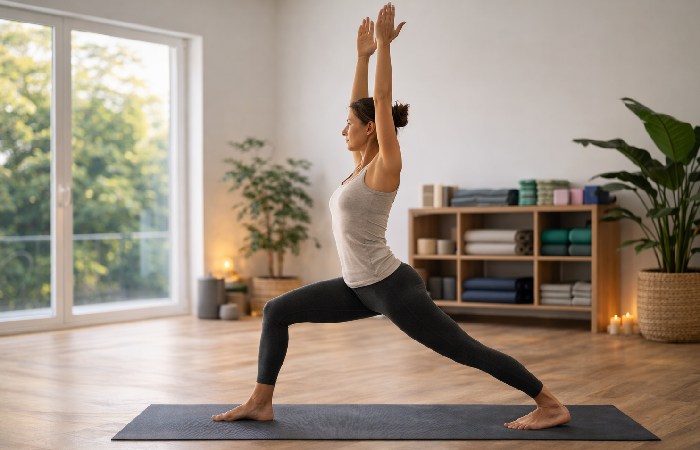
Warrior I (Virabhadrasana I)
What it does: Strengthens legs, opens hips and chest, improves balance and focus.
Why it’s essential: Builds lower body strength and stamina while teaching proper alignment in standing poses.
How to do it:
- Step right foot forward into lunge, back foot turned slightly inward
- Bend front knee to 90 degrees, keeping knee over ankle
- Reach arms overhead, palms facing each other
- Square hips forward
- Hold for 5-8 breaths, then repeat other side
Corpse Pose (Savasana)
What it does: Allows body and nervous system to integrate the practice, promotes deep relaxation.
Why it’s essential: Final relaxation is when many physical and mental benefits consolidate; skipping it reduces overall effectiveness.
How to do it:
- Lie flat on back
- Let feet fall open naturally
- Rest arms alongside body, palms up
- Close eyes and breathe naturally
- Hold for 2-5 minutes minimum
Essential Poses Comparison Table
| Pose | Primary Benefits | Muscles Worked | Difficulty |
|---|---|---|---|
| Child’s Pose | Lower back release, relaxation | Hips, thighs, ankles | Beginner |
| Cat-Cow | Spinal mobility, warm-up | Entire spine, core | Beginner |
| Downward Dog | Full-body stretch, strength | Hamstrings, shoulders, arms, core | Beginner-Intermediate |
| Warrior I | Leg strength, hip opening | Quads, glutes, hip flexors, shoulders | Intermediate |
| Corpse Pose | Stress relief, integration | None (relaxation) | Beginner |
Beginner Yoga Routine (5-10 Minutes)
Perfect for complete beginners or busy mornings when time is limited.
5-Pose Morning Sequence
Total time: 5-8 minutes
- Child’s Pose – 5 breaths (centering and gentle back stretch)
- Cat-Cow – 8 rounds (warm up spine)
- Downward Dog – 5 breaths (full-body wake-up)
- Warrior I – 5 breaths each side (build strength and focus)
- Corpse Pose – 2 minutes (integrate and relax)
Step-by-Step Instructions
Follow this sequence:
Start in a comfortable seated position. Take 3 deep breaths to center yourself.
Move into Child’s Pose for gentle stretching. Focus on relaxing your lower back.
Transition to tabletop position for Cat-Cow. Match each movement to your breath—inhale for Cow, exhale for Cat.
From tabletop, press into Downward Dog. Don’t worry if your heels don’t touch the ground; bent knees are perfectly acceptable.
Step right foot forward into Warrior I. Hold, then switch sides.
Finish in Corpse Pose, allowing your body to completely relax.
Breathing Guidelines
- Never hold your breath during poses
- Inhale through your nose to expand and lengthen
- Exhale through your nose to fold and contract
- Breathe steadily – each breath should take 3-5 seconds
- If you lose your breath, return to Child’s Pose and reset
Intermediate Yoga Routine (15-20 Minutes)
For those comfortable with basic poses and ready for more challenge.
10-Pose Full-Body Sequence
Total time: 15-20 minutes
- Child’s Pose – 5 breaths
- Cat-Cow – 8 rounds
- Downward Dog – 8 breaths
- Plank – 3-5 breaths (core strength)
- Cobra or Upward Dog – 5 breaths (chest opening)
- Warrior I – 8 breaths each side
- Warrior II – 8 breaths each side (hip opening, endurance)
- Triangle Pose – 8 breaths each side (deep side stretch)
- Seated Forward Fold – 10 breaths (hamstring release)
- Corpse Pose – 3-5 minutes
Sun Salutation Flow
Sun Salutations (Surya Namaskar) are dynamic sequences linking multiple poses. One complete round takes about 2-3 minutes.
Basic Sun Salutation sequence:
- Mountain Pose (standing)
- Arms reach overhead (inhale)
- Forward Fold (exhale)
- Halfway Lift (inhale)
- Step back to Plank (exhale)
- Lower to floor or Chaturanga
- Cobra or Upward Dog (inhale)
- Downward Dog (exhale, hold 5 breaths)
- Step forward to Forward Fold
- Rise to standing, arms overhead
- Return to Mountain Pose
Intermediate routine suggestion: Begin with 3-5 Sun Salutations to warm up, then add standing poses and finish with seated poses and Savasana.
Modifications and Progressions
If poses feel too easy:
- Hold standing poses longer (10-12 breaths)
- Add balancing variations (Warrior III)
- Include arm balances (Crow Pose)
If poses feel too challenging:
- Use props (blocks under hands, strap for binds)
- Reduce hold times (5 breaths instead of 8)
- Skip advanced variations
Advanced Yoga Routine (30+ Minutes)
For experienced practitioners seeking challenge and depth.
15-Pose Challenge Sequence
Total time: 30-45 minutes
This routine includes the intermediate sequence plus:
- Headstand or Forearm Stand (3-5 breaths) – full inversion
- Crow Pose (5-10 breaths) – arm balance
- Pigeon Pose (8-10 breaths each side) – deep hip opening
- Wheel Pose (3-5 breaths) – full backbend
- Boat Pose (5-8 breaths) – intense core work
Advanced practitioners should warm up thoroughly with Sun Salutations (5-10 rounds) before attempting challenging poses.
Balance and Inversion Work
Inversions and balances develop strength, focus, and body awareness but require proper preparation:
- Always warm up for at least 10 minutes before inversions
- Use a wall for support when learning
- Focus on alignment over duration
- Exit immediately if you feel strain in your neck or wrists
How to Customize Your Yoga Routine
Not all yoga routines serve the same purpose. Here’s how to tailor your practice to your primary goal.
For Flexibility
Key strategy: Longer holds in passive stretches
Best poses:
- Seated Forward Fold (1-2 minutes)
- Pigeon Pose (2-3 minutes per side)
- Wide-Legged Forward Fold (1-2 minutes)
- Reclining Hand-to-Big-Toe Pose (1-2 minutes per side)
- Butterfly Pose (2-3 minutes)
Routine structure:
- Warm up with gentle flows (5-10 minutes)
- Hold each stretch for 1-3 minutes
- Focus on relaxing into poses, not forcing depth
- Practice 4-5 times per week
- Expected timeline: Noticeable gains in 3-4 weeks
Evidence: Research on women with knee osteoarthritis found that those who practiced yoga in a 60‑minute weekly class plus about 112 minutes at home reported a 38% reduction in pain and a 35% reduction in stiffness after eight weeks, suggesting yoga can help improve joint comfort and mobility in some people.
For Strength
Key strategy: Dynamic flows and challenging holds
Best poses:
- Plank and Side Plank (30-60 seconds)
- Chaturanga push-ups (8-12 reps)
- Chair Pose (30-60 seconds)
- Warrior sequences held longer (15-20 breaths)
- Boat Pose variations (30-60 seconds)
Routine structure:
- 10-15 Sun Salutations to start
- Focus on holding poses longer than comfortable
- Repeat challenging sequences 2-3 times
- Practice 3-4 times per week with rest days
- Expected timeline: Strength gains in 4-6 weeks
Evidence: Harvard Health reports on a study of sedentary adults who practiced yoga for eight weeks, at least twice a week for a total of about 180 minutes. Participants developed greater muscle strength, endurance, flexibility, and cardio‑respiratory fitness, showing that yoga can be an effective strength‑building option even for beginners.
For Stress Relief
Key strategy: Restorative poses with extended breathing
Best poses:
- Child’s Pose (3-5 minutes)
- Legs-Up-the-Wall (5-10 minutes)
- Reclining Butterfly (3-5 minutes)
- Supported Bridge (3-5 minutes)
- Extended Corpse Pose (5-10 minutes)
Routine structure:
- Use props (blankets, bolsters, blocks) for support
- Hold each pose 3-10 minutes
- Practice deep, slow breathing (4-count inhale, 6-count exhale)
- Practice daily or whenever stressed
- Expected timeline: Immediate stress relief during practice; cumulative benefits in 1-2 weeks
Routine Customization Matrix
| Goal | Key Poses | Hold Time | Frequency | Results Timeline |
|---|---|---|---|---|
| Flexibility | Forward folds, Pigeon, Butterfly | 1-3 minutes | 4-5x/week | 3-4 weeks |
| Strength | Plank, Warriors, Boat, Chair | 30-60 seconds | 3-4x/week | 4-6 weeks |
| Stress Relief | Child’s Pose, Legs-Up-Wall, Savasana | 3-10 minutes | Daily | Immediate + 1-2 weeks |
Building Your Routine: Progression Framework
Week 1-2: Foundation Building
Focus: Learning proper form and establishing consistency
- Practice 3-4 times per week
- Stick to beginner routine (5-10 minutes)
- Prioritize form over depth or duration
- Common experience: Some muscle soreness, moderate flexibility gains
- Goal: Build the habit, learn the poses
What to expect: You’ll likely feel stiff in unfamiliar positions. That’s normal. Focus on showing up consistently rather than achieving perfect poses.
Week 3-4: Consistency and Refinement
Focus: Refining alignment and increasing duration
- Practice 4-5 times per week
- Extend sessions to 10-15 minutes
- Start holding poses 1-2 breaths longer
- Common experience: Noticeable flexibility improvement, poses feel more familiar
- Goal: Deepen poses, improve breath control
What to expect: Poses that felt impossible in Week 1 now feel accessible. You’ll notice improved flexibility, especially in hips and hamstrings.
Month 2+: Adding Complexity
Focus: Challenging yourself with new poses and longer sessions
- Practice 5-6 times per week (or 4 times with longer sessions)
- Progress to intermediate routine (15-20 minutes)
- Add 1-2 new challenging poses each week
- Common experience: Significant strength and flexibility gains, mental clarity
- Goal: Maintain consistency, explore advanced variations
What to expect: Your practice becomes self-sustaining. You’ll crave the routine on days you skip it. This is when yoga transforms from exercise to lifestyle. Reports from Harvard Health describe that people who maintain a regular yoga practice over many weeks often develop greater body awareness, more mindful eating habits, and broader improvements in overall well‑being that extend beyond the mat.
Common Mistakes to Avoid
Even experienced practitioners make these errors. Here’s how to prevent them:
1. Skipping the warm-up
Jumping into deep stretches or challenging poses without preparation increases injury risk. Always start with gentle movements like Cat-Cow or easy twists.
2. Holding your breath during poses
Breath-holding creates tension and reduces the effectiveness of poses. If you can’t maintain steady breathing, ease out of the pose slightly.
3. Pushing too hard into stretches
Yoga is not about achieving Instagram-worthy poses. Forcing your body into deep stretches can cause strains. Work at 70-80% of your maximum range.
4. Inconsistent practice
Practicing once a week yields minimal results. The sweet spot is 3-5 times per week. Even 5-minute daily sessions outperform sporadic longer sessions.
5. Ignoring alignment cues
Proper alignment protects your joints and maximizes benefits. When in doubt, reduce the depth of the pose to maintain correct form.
Who Should (and Shouldn’t) Follow These Routines
Best For:
- Complete beginners wanting to start a yoga practice at home
- Intermediate practitioners looking to establish consistency
- People with flexibility or posture goals
- Those seeking stress management tools
- Anyone preferring home workouts to studio classes
Not For (or Requires Modification):
- Recent injuries or surgeries – Consult your doctor or physical therapist before starting
- Pregnancy – Prenatal yoga classes are specifically designed for pregnancy modifications
- Severe back or joint problems – Work with a physical therapist to adapt poses
- Complete immobility – Chair yoga or therapeutic yoga may be better starting points
Health experts at the Mayo Clinic recommend consulting a healthcare provider before starting yoga if you have high blood pressure, glaucoma, sciatica, or are pregnant.
Final Verdict: Choosing the Right Yoga Routine
Start here based on your situation:
If you’re a complete beginner: Begin with the 5-10 minute beginner routine 3-4 times per week. Focus on the 5 essential poses until they feel comfortable (typically 2-3 weeks).
If you want flexibility: Use the flexibility-focused customization with longer holds (1-3 minutes per pose). Practice 4-5 times weekly. Expect noticeable results in 3-4 weeks.
If you want strength: Follow the strength-focused approach with dynamic flows and challenging holds. Practice 3-4 times weekly with rest days. Expect strength gains in 4-6 weeks.
If you want stress relief: Practice the restorative routine daily or whenever stressed. Use props for support and emphasize breathing. Immediate relief during practice, cumulative benefits in 1-2 weeks.
Key principle: Consistency beats intensity. A simple 5-minute routine performed daily outperforms a complex 60-minute routine done sporadically.
Frequently Asked Questions
Q: How long should a yoga routine be for beginners?
A: Beginners should start with 5-10 minutes. This is enough to learn proper form without overwhelming the body. After 2-3 weeks of consistency, gradually increase to 15-20 minutes.
Q: What is the best time of day to do yoga?
A: The best time is whenever you’ll actually do it consistently. That said, morning yoga tends to energize and improve focus for the day, while evening yoga promotes better sleep. Many practitioners prefer morning for this reason.
Q: Can I do yoga every day?
A: Yes, gentle to moderate yoga can be practiced daily. If you’re doing intense strength-focused sequences, take 1-2 rest days per week to allow muscle recovery. Listen to your body—soreness is normal, but sharp pain means you need rest.
Q: What are the basic yoga poses for a routine?
A: The 5 essential poses are Child’s Pose, Cat-Cow, Downward Dog, Warrior I, and Corpse Pose. These form the foundation of most yoga routines and address the body’s primary movement needs.
Q: How do I start a yoga routine at home?
A: Start with the beginner routine in this guide. You need only a yoga mat (or soft surface) and comfortable clothing. Set a specific time each day, start with 5-10 minutes, and gradually progress as poses become familiar.
Q: What’s the difference between a yoga routine and a yoga class?
A: A yoga routine is a self-directed sequence you can practice independently. A yoga class is instructor-led and often includes more variety, adjustments, and community support. Routines are ideal for consistent home practice; classes are great for learning new techniques.
Q: How long before I see results from a yoga routine?
A: Energy boost and stress relief appear immediately. Flexibility improvements become noticeable in 3-4 weeks. Strength gains and posture changes typically appear in 4-8 weeks. Consistency is the key factor—practicing 3-5 times per week accelerates results.
Q: Do I need equipment for a yoga routine?
A: Minimal equipment needed. A yoga mat provides cushioning and grip but isn’t mandatory. Optional props (blocks, strap, blanket) make poses more accessible but aren’t required for beginner routines.
About Health4fitnessblog
Health4fitnessblog publishes practical, easy-to-understand content on health, technology, business, marketing, and lifestyle. Articles are based mainly on reputable, publicly available information, with AI tools used only to help research, organise, and explain topics more clearly so the focus stays on real‑world usefulness rather than jargon or unnecessary complexity.
Disclaimer
This article is for general information only and is not medical advice. Always consult a healthcare professional before starting a new yoga or exercise routine, especially if you have health conditions, are pregnant, or are recovering from an injury. Stop immediately if you feel pain, dizziness, or unusual discomfort.